

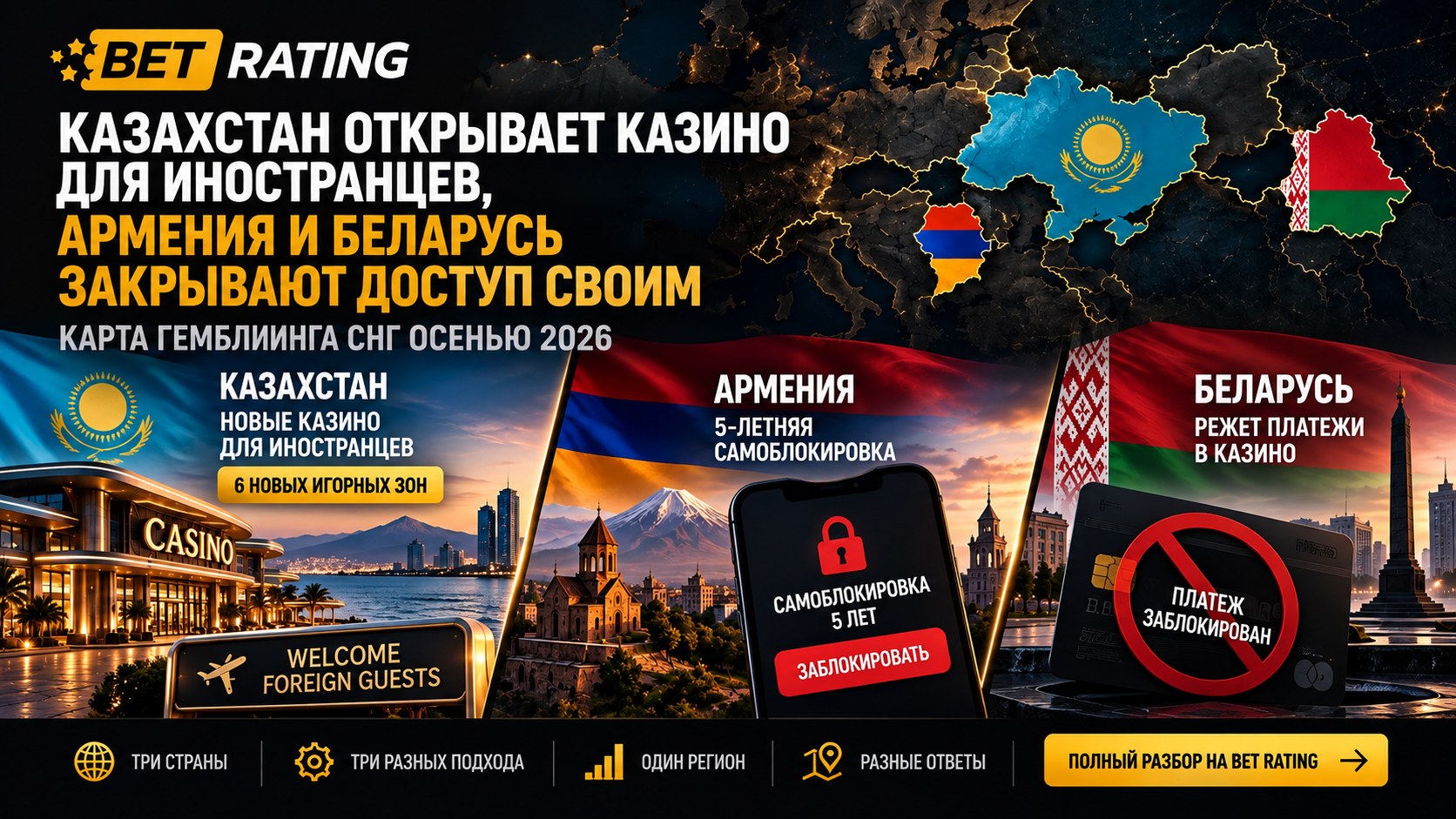
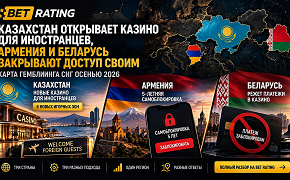
On September 11, a decree regarding six new gambling zones comes into effect in Kazakhstan — but only foreigners will be allowed to play there. Meanwhile, Armenia is preparing a five-year self-blocking button, and Belarus is systematically cutting off payments to casinos. Three neighboring countries in the region — three completely different responses to the same question.
expands — but only for tourists
introduces a 5-year blocking
cuts payments to casinos
This year, in our materials about Kazakhstan and the regional effects of payment blocks, we have analyzed how individual Central Asian countries are tightening regulations on illegal gambling. However, looking at the region more broadly, the picture is not so uniform: while some countries are restricting access to gambling for their own citizens, others are opening new casinos, just not for them.
We explore what is coming into effect in Kazakhstan literally this week, what Armenia is preparing, and what is already happening in Belarus — and why the single trend of "the entire region is tightening regulations" does not actually exist.
In Brief
| Country | What is happening | When |
|---|---|---|
| 🇰🇿 Kazakhstan | 6 new gambling zones — only for foreigners and stateless persons | Decree No. 767 comes into effect on September 11, 2026 |
| 🇦🇲 Armenia | Mandatory self-blocking button for 5 years, betting limit of 20% of income | Adopted in the 2nd, final reading on June 17, 2026, comes into effect 10 days after official publication |
| 🇧🇾 Belarus | Ban on transfers to foreign casinos, limits on card transactions | In effect since February 2, 2026, expanded since June 15, 2026 |
Kazakhstan: casinos for everyone except Kazakhs
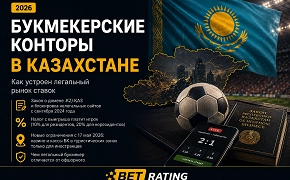
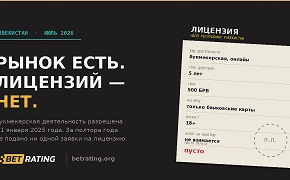
The expansion of gambling zones in Kazakhstan occurred in two stages. On March 16, 2026, President Kassym-Jomart Tokayev signed a law "On Amendments and Additions to Certain Legislative Acts of the Republic of Kazakhstan on Supporting the Tourism Industry and Children's Sports," which supplemented Article 11 of the law "On Gambling Business" with new permitted territories. From May 17, 2026, when the law came into effect, two previous zones — Kapshagay (Konaev) in Almaty region and Burabay in Akmolinsk — were joined by territories in Mangystau region, Zhetysu, Almaty, and East Kazakhstan regions.
On August 26, 2026, Prime Minister Olzhas Bektenov signed Decree No. 767, which was officially published on August 31 — the document comes into effect on September 11, 2026. It establishes a complete and clarified list of six territories and explicitly defines their status — accessible only to foreign citizens and stateless persons:
- the coast of the Caspian Sea in Mangystau region;
- the coast of Lake Alakol and Panfilov district in Zhetysu region;
- Talgar and Uyghur districts in Almaty region;
- Markakol and Zaysan districts in East Kazakhstan region;
- the Baiterek district in West Kazakhstan region;
- the coast of Lake Alakol in Atyrau region.
Access to these zones is formally closed to Kazakhs, regardless of what happens inside the zone itself.
According to the ministry, the most developed project is in Almaty region (Akbulak district, where the necessary infrastructure already exists) and in Mangystau region, where the launch of casinos is expected after the completion of a hotel complex — both projects could theoretically start as early as next year. Work continues in other regions to select specific sites and investors.
Armenia: a button that cannot be canceled for five years
While Kazakhstan is expanding its offline offerings for tourists, Armenia is moving in the opposite direction regarding the online segment — and much more strictly than one might assume from the term "self-blocking."
The author of the legislative initiative, deputy of the ruling faction "Civil Contract" Ayik Sarkisyan, justifies the urgency of the measures with specific market dynamics:
On June 17, 2026, the National Assembly of Armenia approved amendments in the second and final reading. The key requirement — a self-blocking button, mandatory for placement in a prominent location on the interface of all gambling platforms operating in Armenia, including foreign ones. Activating the block on one platform automatically extends to all other legal platforms in the country. After activation, playing in online casinos will be prohibited for five years without the possibility of early cancellation; after the term expires, the block is automatically extended for another five years unless the citizen submits a separate application to lift the restriction five days before the end. At the time of preparing this material, the exact date of the official publication of the law (and, accordingly, its entry into force — 10 days after that) was not specified in open sources.
The law also introduces a limit on participation in online games — no more than 20% of declared annual income — and separately restricts participation for vulnerable categories: recipients of social benefits, pensioners for whom the pension is the only income, participants in bankruptcy procedures, and citizens who spend more than 40% of their annual income on loan repayments.
Belarus: money won't pass until the site is blocked
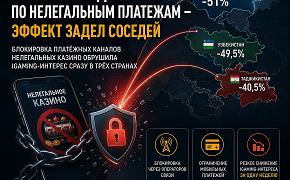
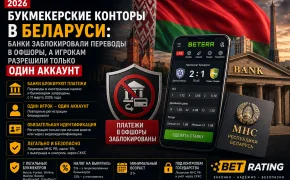
Belarus has chosen a third path — neither expansion (like Kazakhstan) nor restricting access through the interface (like Armenia), but a systematic cutting off of payment infrastructure based on Decree No. 226 from June 6, 2025.
Starting from February 2, 2026, banks are required to block transfers from Belarusians to foreign organizers of gambling games — under the merchant category code (MCC) 7995, which is assigned to bookmakers, lottery tickets, casino chips, and betting on races. At the same time, using someone else's bank cards and documents for gaming is prohibited, and each player is allowed only one account in one virtual establishment.
On June 15, 2026, "Belarusbank" — one of the banks in the country — announced an expansion of its own limits: daily restrictions on card operations were extended to transfers to Belarusian organizations related to gambling, as well as to transfers abroad in general. This refers to the internal policy of a specific bank, not a unified state regulation for all banks in the country: "Belarusbank" set limits of up to 89,000 Belarusian rubles per month for individual debit cards and up to 899,000 Belarusian rubles for corporate cards, but other banks are free to determine their own thresholds within the framework of the general decree No. 226.
Timeline of 2026 in Three Countries
- March 16, 2026KZPresident Tokayev signs the law "On Amendments and Additions to Certain Legislative Acts of the Republic of Kazakhstan on Issues of Supporting the Tourism Industry and Children's Sports", expanding Article 11 of the law "On Gambling Business".
- May 17, 2026KZThe law comes into effect: two previous zones (Kapshagay, Burabay) are supplemented by territories in the Mangistau region, Zhetysu, Almaty, and East Kazakhstan regions.
- February 2, 2026BYIn Belarus, the ban on transfers to foreign organizers of gambling comes into effect.
- March 11, 2026BYAdditional provisions of decree No. 226 on requirements for virtual gambling establishments come into effect.
- June 15, 2026BY"Belarusbank" further expands its own limits on card operations.
- June 17, 2026AMThe National Assembly of Armenia adopts amendments on five-year self-blocking and betting limits in the second and final reading.
- August 26, 2026KZThe Prime Minister signs decree No. 767, establishing a complete list of six zones and the status of "foreigners only".
- September 11, 2026KZDecree No. 767 comes into effect.
Why This Is Not a Unified Trend, but Three Different Responses
At first glance, it may seem that the entire region is uniformly tightening gambling policies — but the three cases address three different tasks. Kazakhstan does not limit demand but segments it: it allows offline casinos as a tourist product, completely excluding its own citizens from it, while simultaneously continuing to suppress online demand within the country. Armenia addresses the problem of specifically measured explosive growth in the online segment through a barrier for the individual — a button that is physically difficult to quickly cancel. Belarus works not with interfaces and zoning, but with the very possibility of technically transferring money.
What Will Happen Next
- Will the Kazakhstani zones in the Almaty region and Mangistau operate in 2027, as expected by the ministry;
- When exactly will the amendments in Armenia come into effect — they start acting 10 days after official publication, which is not yet dated;
- Will Belarus expand payment restrictions to new categories of financial operations;
- Will the Kazakh experience of zoning for foreigners influence the policies of neighboring Central Asian countries.
Conclusion
Autumn 2026 shows that the CIS countries do not have a unified scenario regarding gambling. Kazakhstan has chosen a segmentation model — expanding offline offerings, but exclusively for foreign tourists, while maintaining a strict ban on online casinos for its citizens. Armenia introduces one of the strictest interface barriers in the region — a five-year self-blocking without the right to early cancellation. Belarus systematically closes off the payment infrastructure that makes playing in foreign casinos technically possible.
For a player from the region, the practical conclusion is one: control in the CIS is not weakening anywhere, but specific rules vary greatly from country to country — and will continue to diverge further as each jurisdiction seeks its own balance between budgetary interests, tourism potential, and protection of its own citizens.
Frequently Asked Questions
Will Kazakhs be able to play in the new gambling zones?
No, only foreign citizens and stateless persons will be able to visit casinos and gaming halls in the six new zones.
When does the decree on new gambling zones in Kazakhstan come into effect?
September 11, 2026 — decree No. 767 was signed by the Prime Minister on August 26 and officially published on August 31.
What is the self-blocking button in Armenia?
A mandatory element of the online casino interface, after activation of which participation in games is blocked for five years without the right to early cancellation, with automatic extension for another five years in the absence of a request to lift the restriction.
Is there a limit on betting amounts in Armenia?
Yes, the bill limits participation in online games to no more than 20% of the declared annual income of the citizen.
Can Belarusians transfer money to foreign casinos?
No, starting from February 2, 2026, banks are required to block such transfers under the merchant category code (MCC) 7995.
Have the limits on card operations in Belarus changed recently?
Yes, but at the level of a specific bank: from June 15, 2026, "Belarusbank" expanded its daily limits on transfers related to gambling within the country and introduced its monthly limits on transfers abroad — this is the internal policy of a specific bank within the framework of the general decree No. 226, not a unified regulation for all banks.
Does the expansion of gambling zones in Kazakhstan mean a softening of the online casino policy?
No, these are two independent directions: the expansion of offline zones concerns only foreign tourists, while online casinos for Kazakhs remain under a complete ban. Legal online sports betting, however, continues to operate.
How many gambling zones are there now in Kazakhstan?
Eight: two existing (Konaev/Kapshagay and Burabay) plus six new ones intended only for foreigners.
Sources
- Informburo.kz — "Casinos for foreigners can be opened in six regions of Kazakhstan", September 2026
- Tengrinews.kz — «New Gambling Zones in Kazakhstan: Casinos on the Caspian Sea and Alakol», December 2025
- Zakon.kz — «Two New Casinos to Be Built in Kazakhstan in 2026», June 2026
- ARKA, Kavkasia.net, Arminfo — materials on amendments to the gambling law in Armenia, April – June 2026
- Belarusbank.by, nalog.gov.by — official clarifications on payment restrictions, February – June 2026
This material is prepared by BET RATING based on publications from government bodies and media in Kazakhstan, Armenia, and Belarus as of September 2026. Specific venues, project launch timelines, and the effective dates of individual provisions may be subject to clarification.
Gambling is associated with the risk of losing money.


























































































Comments 0
Please log in on the site, чтобы добавить комментарий, лайк или дизлайк.