

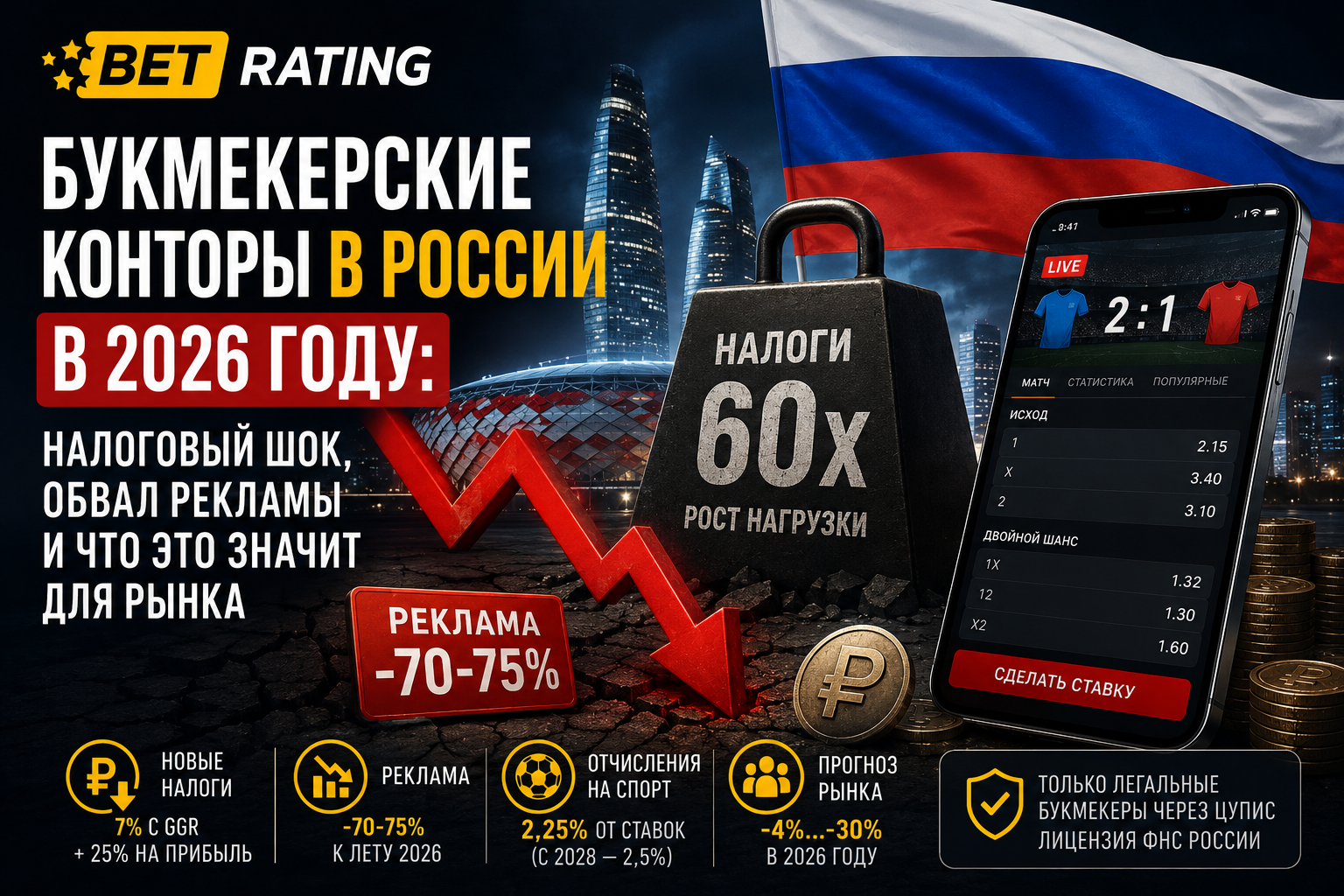
How the regulation of the betting market in Russia changed in 2026: new taxes, increased contributions to sports development, reduced advertising budgets, and forecasts for the future development of the industry.
2026 was a turning point for legal bookmakers in Russia
The Russian sports betting market is the most mature and long-regulated of all the markets we have analyzed in the BET RATING series.
However, it was in 2026 that changes occurred that significantly restructured the economy of the entire industry.
Starting January 1, the taxation system for bookmakers changed, mandatory contributions to sports development increased, and the additional financial burden began to affect advertising, sponsorship contracts, payment infrastructure, and the strategies of the operators themselves.
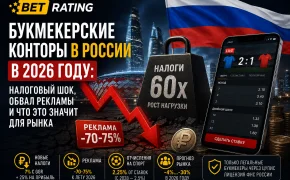
According to estimates from certain market participants, the overall tax burden could have increased by about 60 times. At the same time, advertising and sponsorship budgets could be reduced by 70–75% by mid-summer 2026 compared to the levels before the reform.
Estimates of the further dynamics of the market vary significantly. The unified gambling regulator speaks of a possible decline of 4–5% by the end of the year, while some industry representatives allow for a drop of up to 30% if additional discussed restrictions are adopted.
For the first time in many years, changes have affected not only betting companies but also sports clubs, federations, the advertising market, payment organizations, and ordinary players.
Let's analyze what exactly has changed, who regulates the Russian market, where the bookmakers' money goes, how winnings are now taxed, and why forecasts for the future of the industry differ so greatly.
Chronology of the reform
| Date | Event |
|---|---|
| 2014–2021 | Bookmakers are required to be members of a self-regulatory organization (SRO) for bookmakers. |
| October 1, 2021 | The mandatory SRO model ceases to operate. The main control functions are transferred to the Unified Regulator of Gambling, and the calculations of legal bookmakers are consolidated through the Unified TSUPIS. |
| August 2024 | The Russian Sports Fund is created to accumulate and distribute part of the bookmakers' contributions to the development of professional and mass sports. |
| 2025 | The Russian Sports Fund receives about 18 billion rubles in targeted contributions from bookmakers in the second half of the year. |
| January 1, 2026 | A new taxation system comes into effect: 7% of gross gaming revenue, a profit tax of 25%, and mandatory contributions to sports increase from 2% to 2.25% of the total amount of accepted bets. |
| Q1 2026 | The Unified TSUPIS transfers about 10 billion rubles in targeted contributions. At the same time, bookmakers' revenue decreases by about 1% compared to the same period last year. |
| Summer 2026 | Significant reductions in bookmakers' advertising expenses, sponsorship agreements with clubs, leagues, and sports federations are expected. |
| 2028 | Another increase in targeted contributions to sports is planned—to 2.5% of the total amount of accepted bets. |
Who is who in the regulatory system
The Russian model of betting regulation is built on several structures, each performing a separate function.
Due to similar names and overlapping powers, the ERAI, TSUPIS, Russian Sports Fund, and the Federal Tax Service are often confused with each other.
| Organization | Main Function |
|---|---|
| ERAI Unified Regulator of Gambling |
A public law company that exercises overall market control, monitors compliance with requirements, and participates in organizing the system of targeted contributions. |
| Unified TSUPIS Center for Accounting Interactive Betting Transfers |
A single settlement node through which deposits to gaming accounts, winnings payouts, and other financial operations of clients of legal bookmakers are processed. |
| Russian Sports Fund | Accumulates funds received from bookmakers for sports development and distributes them among sports federations and other recipients in coordination with the Ministry of Sports of Russia. |
| Federal Tax Service of Russia | Licenses bookmakers, conducts tax control, and monitors compliance with operators' obligations to the budget. |
For players, the main practical sign of a legal bookmaker remains the presence of a Federal Tax Service license and conducting all calculations through the Unified TSUPIS.
If an operator accepts money directly, in cryptocurrency, through transfers to individuals, or by other means bypassing TSUPIS, it does not belong to the regulated Russian market.
Taxes: what changed from January 1, 2026
The main goal of the reform is to increase revenues to the federal budget while simultaneously increasing funding for Russian sports.
To achieve this, the government changed several elements of the tax system, affecting both the bookmakers themselves and the procedure for withholding taxes on players' winnings.
| Type of Payment | Before the Reform | From January 1, 2026 |
|---|---|---|
| Tax on Gross Gaming Revenue (GGR) | The burden was significantly lower | 7% of gross gaming revenue |
| Profit Tax | 20% | 25% |
| Targeted Contributions to Sports Development | 2% of the total amount of bets | 2.25% (from 2028—2.5%) |
| Personal Income Tax on Player Winnings | 13% on payouts over 15,000 ₽ | 13% on each win regardless of the amount |
According to the Ministry of Finance, the reform is expected to bring the federal budget more than 60 billion rubles in additional revenues within 2026.
During the discussion of the bill, even higher tax rates were considered, but they were later adjusted. According to representatives of the Ministry of Finance, a sharp increase in the burden could lead to a significant market contraction and a decrease in the tax revenue itself.
The personal income tax rate remains at 13%. However, starting in 2026, the tax applies to each win, not just to payouts exceeding 15,000 rubles.
Exceptions include certain types of sports prizes, such as payouts for victories at the Olympics, World and European Championships, which are exempt from personal income tax under Russian law.
Where advertising budgets are disappearing
One of the most noticeable consequences of the reform has been the reduction of bookmakers' expenses on marketing and sports sponsorship.
According to the head of ERAI, before the reform, operators spent about 100–120 billion rubles annually on advertising, television campaigns, and sponsorship agreements with sports clubs, leagues, and federations.
After the reform takes effect, the market expects these expenses to decrease by approximately 70–75% by mid-2026.
This will become particularly noticeable in the summer when long-term sponsorship agreements begin to expire. Some contracts will not be renewed, and new agreements will be made for significantly smaller amounts.
For professional sports, this means a decrease in private funding, especially for clubs that traditionally received substantial support from bookmakers.
What other changes are being discussed
In addition to the tax changes that have already taken effect, new legislative initiatives continue to be discussed in the industry.
One of the most notable is the proposal to require bookmakers to pay winnings on each bet separately directly to the player's bank card.
Industry representatives believe that such a scheme could seriously change the operation of the Unified TSUPIS, increase the number of banking operations, and lead to higher fees for processing payments.
For now, this initiative remains a topic of discussion, and no final decision has been made on it.
Why forecasts for the market differ so much
After the reform, analysts did not reach a consensus on the scale of its consequences.
| Source | Forecast |
|---|---|
| ERAI (based on Q1 results) | Revenue decline of approximately 1% |
| ERAI (forecast for the entire 2026) | Market decline of 4–5% |
| Industry Participants | With additional restrictions, the market could shrink by up to 30% |
The reason for such a significant difference lies in different approaches to assessing the future.
The regulator is based on already adopted norms, while market representatives consider still-discussed initiatives, rising costs for compliance, KYC, AML, payment infrastructure, and possible reductions in marketing activity.
Most experts agree on one point: the new rules will accelerate market consolidation, making it significantly harder for smaller operators to compete with the largest bookmakers in the country.
Legal bookmaker vs. illegal
| Criterion | Bookmaker with FNS License | Illegal or Offshore Operator |
|---|---|---|
| License | Issued by the Federal Tax Service of Russia | No Russian license |
| Settlements | All deposits and payouts go through the Unified TSUPIS | Operations are conducted outside the TSUPIS system |
| Tax on Winnings | 13% withheld by the tax agent | The player may need to declare income themselves |
| Contributions to Sports | 2.25% of the total amount of bets is directed to sports development | No targeted contributions |
| Self-Exclusion Registry | Mandatory compliance | Not guaranteed |
| State Supervision | ERAI and the Federal Tax Service of Russia | Outside Russian jurisdiction |
| Dispute Resolution | Within Russian legislation | Depends on foreign jurisdiction and operator rules |
The main sign of a legal bookmaker remains the presence of an FNS license and conducting all financial operations through the Unified TSUPIS.
If a company offers deposits through transfers to individuals, cryptocurrency, or other means bypassing TSUPIS, it does not belong to the regulated Russian market.
Frequently Asked Questions
How much have taxes for bookmakers increased in 2026?
According to estimates from certain market participants, the overall burden could have increased by about 60 times. From 2026, a tax of 7% on gross gaming revenue has been introduced, the profit tax rate has been increased to 25%, and targeted contributions to sports have risen to 2.25% of the total amount of bets.
What is the tax on player winnings?
The personal income tax rate is 13%. From 2026, the tax applies to each win regardless of its size. At a legal bookmaker, the tax is usually withheld automatically.
What is the Unified TSUPIS?
It is a settlement center through which deposits to gaming accounts and payouts of winnings to clients of legal Russian bookmakers are processed.
What is the purpose of the Russian Sports Fund?
The fund accumulates part of the targeted contributions from bookmakers and directs them to finance sports federations, mass, youth, and professional sports.
Why are bookmakers reducing advertising?
Due to the increased tax burden and rising mandatory payments, operators are revising their marketing and sponsorship budgets. According to industry forecasts, expenses may decrease by 70–75% compared to pre-reform levels.
How much can the betting market shrink?
ERAI predicts a moderate decline of 4–5% by the end of the year. Some industry participants allow for a drop of up to 30% if additional restrictions are adopted.
How to check the legality of a bookmaker?
It is necessary to check for the presence of an FNS license, the legal entity of the operator, and ensure that all deposits and payouts go through the Unified TSUPIS.
Conclusion
The main feature of the 2026 reform is that the state significantly increased the financial burden on the legal betting market while simultaneously aiming to raise tax revenues and the volume of funding for Russian sports.
For the largest operators, the new conditions mean reduced advertising expenses, a revision of sponsorship agreements, and increased costs for tax support, compliance, and payment infrastructure.
For smaller companies, the reform may be much more painful, which is likely to accelerate market consolidation around the largest brands.
For the average player, the main change is the new procedure for withholding personal income tax, which now applies to each win, as well as further strengthening control over calculations, identification, and self-restriction.
Whether it will be possible to maintain a balance between the interests of the budget, sports organizations, bookmakers, and players will become clear after the publication of the full results for 2026.
















































Comments 0
Please log in on the site, чтобы добавить комментарий, лайк или дизлайк.