


The outcome of a sporting event can be discussed as a bet with odds or as a contract with a changing price. Externally, the interfaces differ, but the user's interest often begins with one question: what will happen next? This is why prediction exchanges have become a notable topic in the betting industry.
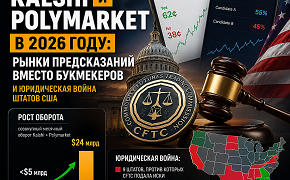
In October's industry publications, Macquarie's estimate appeared: the taker volume of participants could approach $187 billion by 2026. Let's explore what this amount measures, how event contracts are structured, and why the new format does not eliminate financial risk.
This material was prepared on October 15, 2026. The mechanics are illustrated with a simplified example. The rules of a specific contract and platform may vary.
$187 Billion — Forecast of Turnover, Not Earnings
According to reports from EGR and other industry publications, Macquarie analyst Chad Beynon estimated the taker volume of prediction exchanges for 2026 at approximately $186.8 billion, or rounded to $187 billion. This figure is compared to $22 billion from the previous year: about an 8.5-fold increase. At the same time, the new estimate is slightly lower than the previous forecast of $190 billion.
This is a secondary retelling of Macquarie's estimate: the BET RATING editorial team did not receive the original analytical report and did not conduct an independent calculation. The term taker volume is retained to avoid presenting a specific metric as a universal assessment of all market money.
It is fundamentally important for the reader to distinguish between trading volume, operator revenue, and participant financial results. The same position can change hands before the final settlement. Therefore, greater activity does not in itself indicate a comparable influx of new money or user profits.
The full-year forecast is also not equal to the results already achieved. A correct headline reports the expected volume, rather than declaring the annual figure as final.
How Prediction Exchanges Work: A Simple Model
In the basic model, an event contract is tied to a question with "yes" and "no" answers. In Kalshi's official explanation, a correct outcome yields $1 at settlement, while an incorrect one yields $0. The purchase price is formed through participant bids.
Let's illustrate the mechanics with a hypothetical example. Suppose the "yes" contract costs $0.40, and the payout upon confirmation of the outcome is $1. Buying 100 such contracts costs $40 without commissions.
| What Happened | Amount After Settlement or Sale | Result Relative to Costs of $40 |
|---|---|---|
| "Yes" Outcome Confirmed as per Rules | $100 | +$60 |
| "Yes" Outcome Not Confirmed | $0 | −$40 |
| All Contracts Sold Before Settlement at $0.55 | $55 | +$15 |
The last line assumes that a buyer was indeed found for the entire volume at the specified price. The displayed quote does not guarantee this by itself. Commissions would reduce the positive result or increase the overall expense.
If held until settlement, the gross payout of $1 on the spent $0.40 arithmetically corresponds to a multiplier of 2.50. This is merely a comparison of the monetary result in the example. The settlement rules, exit availability, and expenses may differ from those of a bookmaker's bet.
How Prediction Exchanges Differ from Traditional Bookmakers
Below is a comparison of a typical bookmaker bet with fixed odds and a basic exchange model. It helps to understand the structure of the products but does not describe all platforms or determine their legal status.
| Criterion | Bookmaker with Fixed Odds | Exchange Model of Event Contracts |
|---|---|---|
| Main Reference | Odds and Bet Amount | Price and Number of Contracts |
| Offer Formation | Bookmaker Publishes the Line | Participant Bids Form Available Prices |
| Exit Before Result | If Cash Out is Available, According to Bookmaker's Terms | Position Sale Possible with Counter Bid |
| What Affects Expenses | Margin in Odds and Product Terms | Spread, Commissions, and Bid Execution Price |
| What to Read | Rules for Accepting and Settling Bets | Contract Specifications and Rules for Determining Outcomes |
The exchange interface makes changes in expectations particularly noticeable: participants see price movements. However, a more detailed display of the process does not mean that predicting outcomes has become easier. It merely shows the cost of the accepted risk differently.
Why Bookmakers Are Interested in Prediction Exchanges
BET RATING Editorial Conclusion: potential competition arises where products vie for the same time, attention, and budget of the user. If a person is following a sporting event, different services may offer them various ways to express their opinion on the outcome.
However, this does not imply that one format will necessarily displace another. Such an assessment would require comparable data on customers, retention, financial results, and service availability. A single turnover forecast does not answer these questions.
It is more interesting to observe specific changes: what markets emerge, how clear their conditions are, and how transactions are executed. For the user, the quality of the rules and interface may be more important than the new category name.
For the same reason, it is incorrect to consider any prediction exchange as a crypto project. To understand the product, one must separately look at the operator, the structure of settlements, and the contractual terms. The mechanics of prediction and the method of storing money are different characteristics.
Why Market Price Does Not Guarantee a Correct Prediction
The CFTC explains that the price reflects the perceived probability of the outcome by participants. This is a useful reference but not an objective measurement of the future. In our example, a price of $0.40 can be interpreted as a market reference of about 40% before considering the specifics of the transaction; it does not confirm that the true probability is known.
Three elements require special attention: liquidity, or the available volume of counter bids; spread between buy and sell prices; and commissions. These can change the result even with a small price movement.
There is also a risk of ambiguous wording. Before making a deal, it is important to understand the source of the result, the moment the event ends, and the procedure for resolving disputes. For example, the result at the end of regular time and the result after extra time are different conditions, even when referring to the same match.
Separately, CFTC staff noted in a notice dated September 22, 2026, the increased risk of manipulation in contracts dependent on the words or actions of a specific individual. This warning pertains to a specific type of event market; applying it as a blanket accusation to any platform would be incorrect.
Regulation Remains an Important Part of the Story
The dispute over sports event contracts in the U.S. continues. In October, the NFL supported a petition for the Supreme Court to consider the delineation of powers between federal regulators and states. This is the position of a party in a legal dispute, not a final court decision regarding the entire industry.
For readers from Russia, Kazakhstan, or Uzbekistan, the American dispute does not establish local rules. Foreign registration or oversight does not automatically mean permitted access from any country. It is necessary to check the current restrictions of specific services and applicable local requirements.
In this article, we explain the structure of the market, rather than offering a way to circumvent territorial restrictions or individual legal conclusions.
What We Will Monitor Next
For the development of the topic, not only new trading volume records are important. We will pay attention to the transparency of settlements, the availability of information on fees, changes in rules, and confirmed decisions by regulators and courts.
The most useful question for the reader is: what specific risk is hidden behind this price? It helps to assess both the familiar bet and the event contract without expecting that a modern interface itself creates an advantage.
Frequently Asked Questions
Is a prediction exchange a bookmaker?
Products may have similar events, but the mechanics of trading and contractual terms differ. Legal qualification depends on the country and product; there is no universal answer for all services.
Can a contract be sold before the event ends?
In the exchange model, such an opportunity is provided, but execution depends on market rules and the presence of counter demand. Sale at the desired price cannot be guaranteed.
$187 billion — is that the profit of the platforms?
No. The article presents a forecast of taker volume, recounted by industry publications. It does not show the net profit of operators or earnings of participants.
Can the price be considered an accurate probability?
It reflects the market assessment, which changes and can turn out to be erroneous. The price does not guarantee the occurrence of the event.















































































































































Comments 0
Please log in on the site, чтобы добавить комментарий, лайк или дизлайк.