

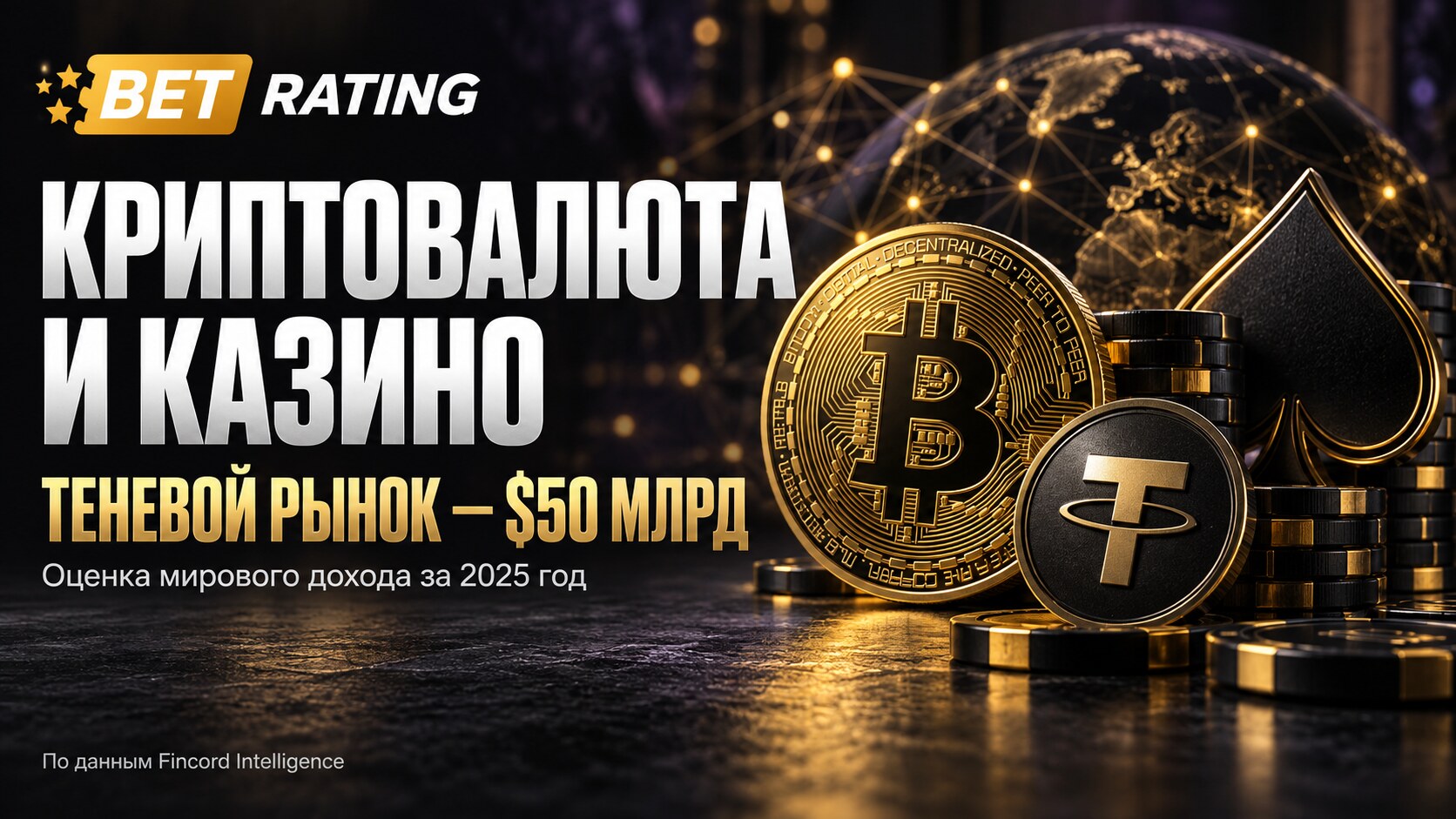
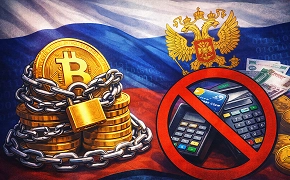
The global illegal online gambling market could generate around $50 billion in gross revenue by 2025. This estimate comes from Fincord Intelligence in a study highlighted by the British Betting and Gaming Council in September 2026. Reports on the study also mention that approximately 35% of payments on illegal gambling sites are made using cryptocurrency.
Behind these figures lies a question that concerns the Russian-speaking audience: what does a user actually gain when a bookmaker or online casino offers a deposit in cryptocurrency? A convenient payment method, additional privacy, or risks that only become apparent when trying to withdraw funds?
BET RATING examines what is known about the study, why cryptocurrency payments do not confirm the reliability of the operator, and what differences are important for players from Russia and the CIS countries.
What is known about the Fincord Intelligence study
On September 8, 2026, NEXT.io published an article about the assessment of global illegal online gambling. According to the study, around 5,000 operator structures utilized more than 15,000 websites and applications. Several addresses may belong to one business, so the number of websites cannot be considered the number of independent companies.
The authors pay special attention to attracting individuals who have previously self-excluded from gambling. In the British context, this particularly refers to platforms advertising the absence of restrictions from the GAMSTOP system.
Source: NEXT.io — publication about the Fincord Intelligence study .
$50 billion — this is not the amount of cryptocurrency deposits
In a news headline, it is easy to confuse several different indicators: betting turnover, account top-ups, operator revenue, and their net profit. To understand the scale of the market, these must be separated.
| Indicator | What it describes |
|---|---|
| Deposits | Money deposited by users into gaming accounts. |
| Betting turnover | The total amount of bets placed or gaming stakes. The same money can be involved in turnover multiple times. |
| Gross gaming revenue, GGR | Usually the difference between the total amount of bets and the winnings paid out, before deducting operational expenses and taxes. |
| Net profit | The result after accounting for relevant expenses and taxes. |
For example, in a hypothetical model, players placed bets of 100 units and received payouts of 95. The gross gaming revenue would be 5 units. From this example, it cannot be determined how much money was initially deposited into the accounts: users could have placed bets multiple times with already received winnings.
What does the estimate of cryptocurrency's share at 35% mean
According to a publication by Casinos.com, researchers estimate the share of cryptocurrency at about 35% of payments on illegal gambling sites. It also provides a forecast for this share to increase to around 70% by 2030. The forecast is not a definitive future outcome.
Without methodological clarifications, it is impossible to confidently say whether the share was calculated based on the number of transactions or their value, which networks and tokens were considered, and how complete the sample was. Therefore, multiplying $50 billion by 35% and declaring the result as the "volume of crypto deposits in casinos" is incorrect.
Source: Casinos.com — information about cryptocurrency payments and researchers' forecasts .
Why cryptocurrency is convenient for bookmakers and online casinos
A cryptocurrency transfer allows for the transfer of a digital asset between addresses without conducting the operation through a card payment network. This is a separate payment infrastructure with its own fees, confirmation rules, and technical limitations.
However, the user's journey usually does not end with the blockchain. Before the transfer, purchasing the asset and identity verification on an exchange may be required, and after receiving the payout, exchanging and transferring to regular money. Therefore, convenience should be assessed across the entire chain, not just by the time taken to send tokens.
USDT and Bitcoin — different types of risk
Bitcoin can significantly change in value relative to regular currencies. If the gaming balance is expressed in BTC, its monetary equivalent depends not only on the game results but also on the market price of the asset.
USDT is designed to maintain a peg to the US dollar. However, using a stablecoin does not eliminate the risks of the operator itself, the storage of funds, the chosen network, or the issuer. Even a stable currency unit does not guarantee that the platform will fulfill a withdrawal request.
Editorial conclusion: the method of topping up and the reliability of the company must be assessed separately. Support for a well-known token says nothing about who operates the site and how disputes are resolved.
The main risk: the transfer went through, but the money remains with the platform
A successful transaction confirms the movement of an asset. It does not confirm the honesty of the recipient, the correctness of bonus accrual, or the willingness to return the remaining balance. After the deposit is credited, the user depends on the rules and actions of the operator.
1. Confirmation in the blockchain does not replace payment reversal
The Federal Trade Commission warns: cryptocurrency payments are usually irreversible. In many cases, the recipient's participation is required for a refund. One cannot rely on a built-in dispute mechanism similar to that of a bank card.
If a dispute arises, the saved conditions, correspondence, website address, and transaction ID are significant. However, having this evidence does not guarantee the recovery of funds. More about the risks of crypto payments — in the FTC's guide .
2. The absence of a name in the address does not mean complete anonymity
In Bitcoin, the transaction history is public and stored on the network. The address does not contain personal data, but a connection to a person can emerge through a service that knows their identity or through disclosed transaction details.
Therefore, the promise that "cryptocurrency makes payments invisible" is misleading. Bitcoin.org separately explains the transparency and traceability of transactions .
3. Tokens may be subject to issuer restrictions
The terms of Tether provide for the possibility of restrictions and freezing under certain circumstances. This is a separate risk that should not be confused with the casino itself blocking a gaming account. Tether Terms .
This does not mean that any transfer from a gaming platform will automatically be frozen. However, the assertion that digital assets are always beyond control is also incorrect.
4. Bonus balance may differ from the amount available for withdrawal
When evaluating an offer, it is important to distinguish between your own funds, bonus credits, and the amount allowed for withdrawal. You should check the wagering requirements, maximum bet, expiration date of the offer, and withdrawal limits. A large number on the screen does not necessarily mean that the entire amount can be withdrawn.
What this means for players from Russia and the CIS
Russia, Kazakhstan, Uzbekistan, and other countries in the region have different regulatory regimes for gambling and digital assets. There is no single permission "for the entire CIS" arising from the availability of cryptocurrency payments.
When reading international news, it is helpful to separate three questions: where the company is registered, where it is allowed to provide services, and whether a specific payment method is permitted. The Russian language of the interface or the ability to open the site does not answer these questions.
Statistics from research cannot be automatically transferred to the region. From a global assessment of the share of cryptocurrency, it does not follow that the same number of payments are made by Russian or Kazakh users. Separate data by country is needed for such a conclusion.
For BET RATING, this information primarily concerns the quality of operator verification: an attractive interface and fast deposits should be accompanied by clear information about the company, payout rules, and complaint handling.
What information about the operator really matters
When analyzing a bookmaker or online casino, it is more useful to look at verifiable information rather than promises of "instant," "anonymous," and "unrestricted."
- Legal entity. Who is listed as the party to the user agreement, and does the name match the licensing data?
- License and domain. Can the permission be confirmed in the regulator's registry, and does it relate to the specific site?
- Withdrawal conditions. Are processing times, fees, limits, and reasons for additional verification specified?
- Identification. Does the company explain in advance what documents and information may be required?
- Bonus rules. Can restrictions be understood before making a deposit, rather than after a dispute arises?
- Complaint procedure. Is there a clear procedure for addressing complaints and information about who handles disputes?
No single point guarantees safety. However, the absence of answers to several questions at once is a reason not to trust promotional promises.
A separate warning sign is an unexpected demand to send additional funds to a third-party wallet to "unlock winnings," "pay for verification," or "activate withdrawal." You should not continue transfers under pressure: first, you need to verify the basis of the demand through official communication channels.
Frequently Asked Questions about Cryptocurrency and Casinos
Are all crypto casinos illegal?
The payment method does not determine this. It is necessary to check the operator's permissions, the territory of their operations, and applicable requirements for the specific service.
Does $50 billion represent the volume of bets in cryptocurrency?
No. In publications, this is an estimate of the gross income of global illegal online gambling for 2025. It does not equal the sum of cryptocurrency deposits.
Does a payout in USDT prove the reliability of a casino?
A single successful payout demonstrates the execution of a specific transaction. It does not confirm the company's solvency in the future and does not replace the verification of its documents.
Can a confirmed transfer be canceled?
Typically, the sender cannot independently cancel a confirmed cryptocurrency transaction. The possibility of a refund depends on the recipient, involved services, and circumstances.
Why can a platform without identity verification be risky?
The promise of no verification does not explain how the service meets applicable requirements and under what conditions it considers disputes. Additionally, advertising may not match the terms of the user agreement.
BET RATING Conclusion
September publications about the Fincord Intelligence study provide grounds to discuss not only the scale of shadow gambling but also the difference between payment convenience and user protection.
Cryptocurrency solves the problem of asset transfer. The reliability of a bookmaker or casino is determined separately: by documents, working conditions, and fulfillment of obligations. Neither a well-known token, nor a high bonus, nor a beautiful website replaces this verification.




































































































Comments 0
Please log in on the site, чтобы добавить комментарий, лайк или дизлайк.