
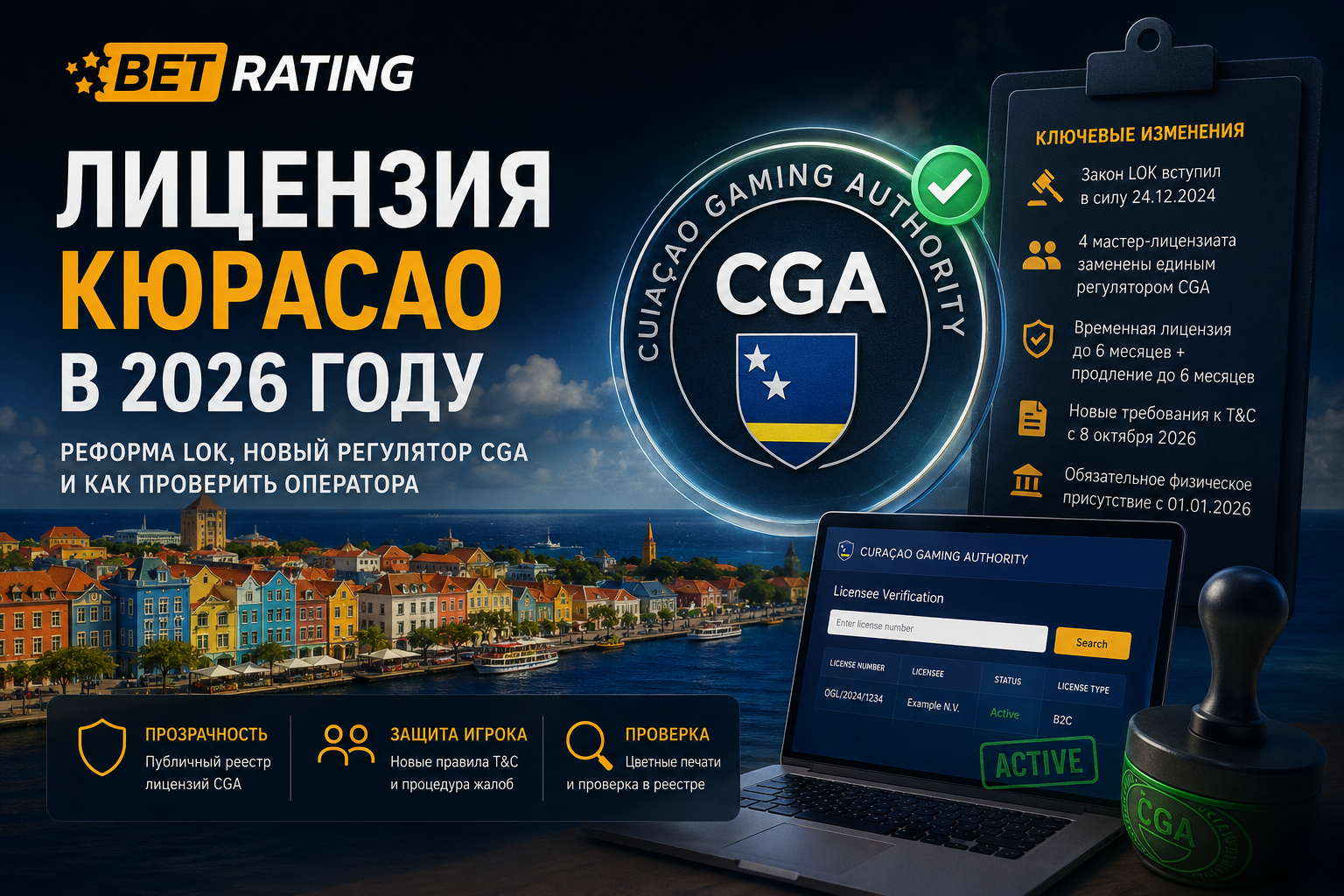
On December 24, 2024, a law came into effect that was supposed to permanently change the reputation of the Curaçao license. We analyze what has really changed, why the regulator itself faced a crisis in 2025, and how this affects operator verification today.
In almost every review of an offshore bookmaker or casino, you come across the phrase “operating under a Curaçao license.” Until recently, this phrase meant little: for decades, the island operated a system where several master license holders resold the right to operate under their name to hundreds of operators without a single public registry.
On December 24, 2024, this system formally ceased to exist. We explore what the new LOK law brought, why the regulator itself faced a serious internal crisis just a year after the reform, how much a license costs now, and how to actually verify that an operator holds one.
In Brief
| Parameter | Value |
|---|---|
| Law | LOK (Landsverordening op de Kansspelen), in effect since 24.12.2024 |
| Regulator | Single — Curaçao Gaming Authority (CGA) |
| Master License System | Abolished, old sub-licenses expired in January 2025 |
| Temporary License | Up to 6 months + extension for another 6 months |
| Final (definitive) License | Indefinite, until suspension or revocation |
| One-time Application Fee | ≈€4,592 |
| Annual B2C License Fee | ≈€47,450 |
| Physical Presence Requirement | Mandatory from January 1, 2026 |
| Mandatory Local Employee (key person) | By April 1, 2027 |
| New User Agreement Requirements | Published April 8, 2026, effective October 8, 2026 |
How the Old System Worked
Since 1993, Curaçao operated a master/sub-license model: four companies — Cyberluck, Antillephone, Gaming Curacao, and Curacao Interactive Licensing — held the main licenses and issued sub-licenses to operators worldwide. Verifying the actual holder of a sub-license and their history was often nearly impossible: there was no single public registry.
LOK Reform: What Changed Formally
- September 2023The Curaçao government announces the reform and the creation of a new regulator to replace the former Gaming Control Board.
- December 17, 2024The Curaçao parliament approves the LOK law (13 votes in favor, 6 against).
- December 24, 2024LOK is signed and comes into effect. The former regulator is renamed the Curaçao Gaming Authority (CGA) and becomes the sole body issuing licenses directly.
- January 2025All old sub-licenses issued under the previous system cease to be valid.
- October 15, 2025Orange transitional stamps (temporary application status) lose their validity.
- January 1, 2026The requirement for physical presence and local operational infrastructure in Curaçao becomes mandatory for licensees.
From this point on, the license is divided into two formally different stages. An operator that does not meet all requirements immediately can obtain a temporary license for up to 6 months with the possibility of one extension for another 6 months. If, after this period, the CGA is satisfied with the operator's compliance, a final (definitive) license is issued — indefinite, valid until suspension or revocation.
The Crisis Surrounding the Regulator Itself
The reform did not go smoothly — and this is important to know, as it directly affects how quickly and predictably the CGA currently makes decisions on operator applications.
The practical consequence of this turbulence: according to the official statement from the CGA on December 23, 2025, the regulator directly acknowledged that it was unable to make final decisions for some operators whose second (extended) temporary license was expiring — such companies were allowed to continue operating without a clear deadline, “until the verification is completed.” For the operator, this means that even diligent compliance with all procedures does not guarantee a quick transition to an indefinite license.
How Much Does a License Cost Now
For comparison: under the old system, a typical sub-license could cost the operator about €18,000–20,000 per year — meaning a direct CGA license is significantly more expensive, but in return provides a status that is verified in a public registry and does not depend on the reputation of a specific master licensee.
B2B License for Suppliers: Not as Broad as It May Seem
A separate category of license is provided for suppliers of critical gambling services and goods — developers of gaming software, RNG engines, betting platforms, betting acceptance and settlement systems, live studios. This is not a requirement for all payment services or IT contractors in general, but specifically for suppliers whose products directly affect the outcome of the game or regulatory compliance, and who are established in Curaçao.
What Has Changed for Players: New Rules for User Agreements
On April 8, 2026, the CGA published a separate guideline on user agreement policies (Policy Guideline: Terms and Conditions, version 1.0). This is one of the few changes in the reform that directly affects the average player, not just the operator.
The rules pertain to account closures, handling inactive accounts, payment procedures, refund processes, and processing cryptocurrency transactions. Operators have until October 8, 2026 — exactly six months from the publication date — to align user agreements with these requirements and upload the updated version to the CGA portal.
What CGA Formally Requires Regarding Dispute Resolution
The wording about ADR (Alternative Dispute Resolution) is often conveyed too straightforwardly — as "ADR is mandatory for all without exception." The official position is softer: the absence of an approved alternative dispute resolution mechanism, if required by specific license conditions, may be grounds for refusal to issue or transition to a final license. At the same time, a separate CGA policy on handling complaints (Player Complaint Policy) establishes specific timelines:
- complaints related to responsible gaming — review within 5 working days;
- all other types of complaints — review within 4 weeks, with the possibility of extending by another 4 weeks upon notifying the player;
- complaints can be submitted within 6 months from the date of the incident.
The CGA does not directly handle individual complaints, but ensures that the operator has a functioning and transparent procedure for processing them.
How to Verify a Curaçao License in 2026
The CGA registry is public, but verification still needs to be done independently — mere mention of the word "Curaçao" in the footer of a website proves nothing. In February 2026, the CGA publicly exposed a site with a fake digital license seal — a specific example of why independent verification is necessary, rather than relying on a visual badge.
What This Means for Players from the CIS and Central Asia
The overwhelming majority of operators that accept players from Russia, Kazakhstan, Uzbekistan, and other countries in the region without a local license operate specifically under a Curaçao license. The reform makes the license itself significantly more formally verifiable — but it does not change the main legal fact that we have mentioned in every review of national regulation: a foreign offshore license does not replace the requirements of local legislation and does not provide player protection before the national authorities of the country where they are actually located.
What Will Happen Next
- how the CGA will close "stalled" cases of operators with expired second terms of temporary licenses;
- how the industry will react to the deadline of October 8, 2026, regarding the new T&C rules;
- whether B2B licensing for suppliers will come into effect in December 2026 as scheduled;
- how the requirement for physical presence and a local employee (by 2027) will affect the number of operators willing to remain in Curaçao.
Conclusion
The Curaçao license in 2026 is no longer the same license it was even three years ago. The LOK law, which came into effect on December 24, 2024, abolished the system of four master licensees and replaced it with direct licensing through a single regulator, the CGA, with a public registry, colored digital seals, and a formal complaint review procedure.
However, the reform has not been without turbulence: the CGA itself experienced a serious internal crisis in 2025, related to accusations against the former finance minister, the resignation of the supervisory board, and delays in decisions on operator applications.
For the reader, this means one thing: the "Curaçao" badge on an operator's website today requires not less, but more independent verification of the specific license number in the official registry — but it still cannot fully replace a national license.
Frequently Asked Questions
When did the Curaçao license reform take effect?
```htmlThe LOK law was signed and came into effect on December 24, 2024, replacing the previous master and sub-license system with direct licensing through the single regulator CGA.
What is the current cost of a Curaçao license?
The one-time application fee is about €4,592, and the annual burden on the holder of a B2C license is approximately €47,450, of which about €24,490 goes to the Curaçao treasury and €22,960 to the CGA regulator.
Is it true that Curaçao had issues with its regulator?
According to industry reports (iGaming Business, Fast Offshore), there was an internal crisis in 2025: the former finance minister was accused of violations in issuing temporary licenses, and the entire supervisory board of the CGA resigned. The CGA itself officially confirmed only the delay in decisions regarding licenses at the end of 2025.
When is a B2B license required for gambling service providers?
Mandatory licensing for providers of critical services established in Curaçao will be introduced approximately two years after the LOK comes into effect—around December 2026.
How can I verify that a bookmaker actually has a Curaçao license?
You need to check the exact license number, the name of the legal entity holding the license, and the status of the colored digital seal against the data on the official CGA portal, rather than relying solely on the mention of the word "Curaçao" on the website.
What will change for players starting October 8, 2026?
Operators will be required to obtain explicit, active consent to the user agreement during registration, rather than relying on implied consent; rules regarding payouts, refunds, inactive accounts, and cryptocurrency transactions will be tightened.
Is the ADR mechanism mandatory for all holders of a Curaçao license?
Formally, the absence of an approved alternative dispute resolution mechanism, if required by the terms of the license, may be grounds for refusal—this is not an unconditional requirement for all operators without exception, but an important element of the player protection system.
Does a Curaçao license make an operator legal in Russia, Kazakhstan, or Uzbekistan?
No. An offshore license regulates the relationship between the operator and the jurisdiction that issued it, but does not replace the requirements of national legislation of the country where the player is actually located.
Sources
- Official portal of the Curaçao Gaming Authority—License Management Portal (portal.gamingcontrolcuracao.org), FAQ, and licensing conditions
- Text of the law Landsverordening op de Kansspelen (LOK), came into effect on 24.12.2024
- iGaming Business—materials on the extension of temporary licenses and the corporate crisis of the CGA, 2025–2026
- Curaçao Chronicle—“Curaçao Gaming Authority Tightens Rules for Licensed Operators,” April 2026
- Policy Guideline: Terms and Conditions (Version 1.0), CGA, April 2026
This material was prepared by BET RATING based on the official CGA portal, the text of the LOK law, and industry sources as of August 2026. Individual quantitative estimates (the number of operators before the reform, the share of illegal sites) are based on journalistic investigations and industry assessments, not on official statistics from the regulator, which is noted separately in the text. Licensing requirements and timelines may be clarified by the CGA.
Gambling involves the risk of losing money. Having an offshore license does not replace the requirements of national legislation in the player's country.
18+ • Betting involves the risk of losing money. BET RATING is an informational platform.
Article discussion
There are no comments yet. Ask a question or start a discussion.