

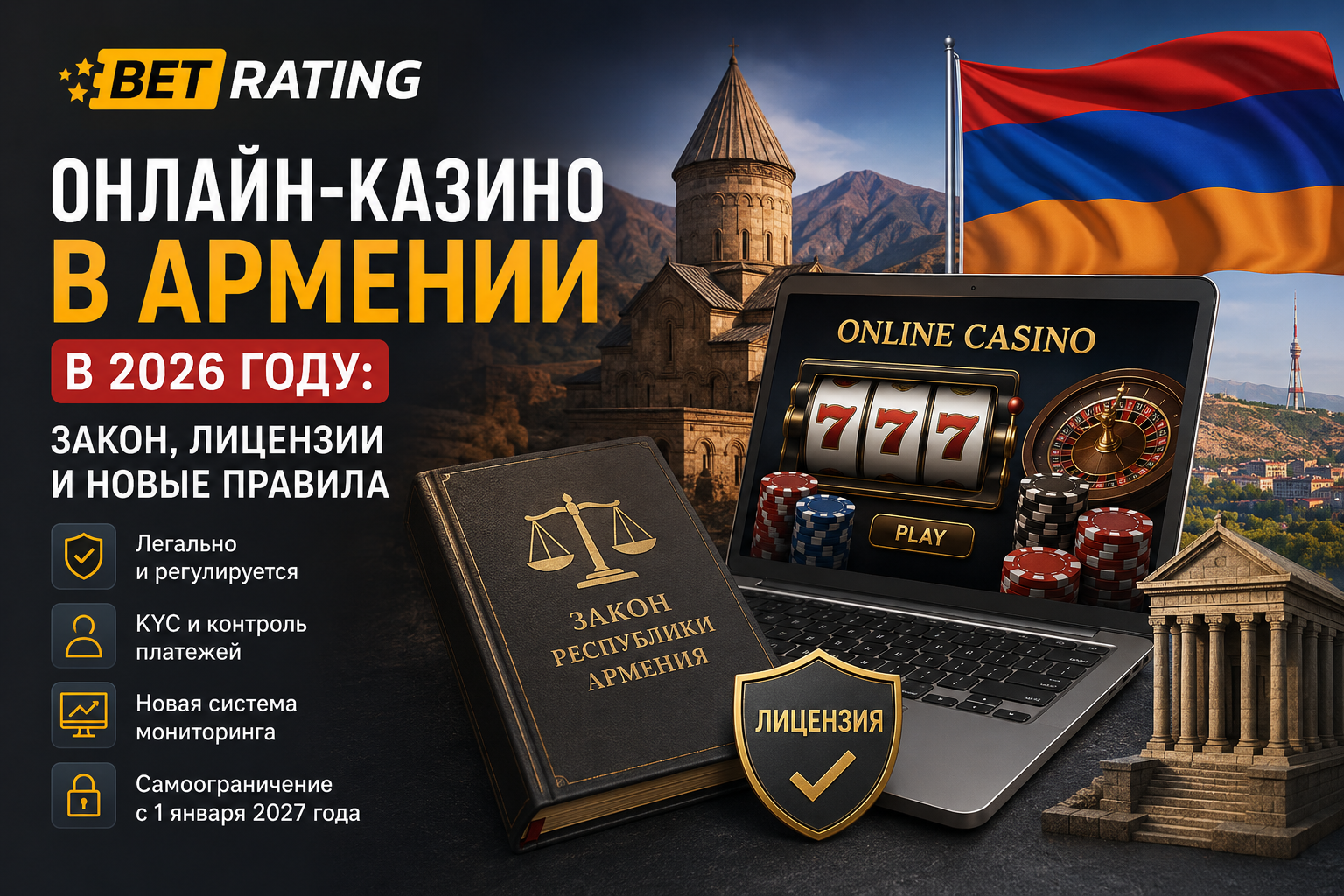
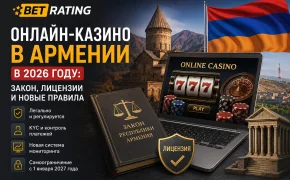
Armenia — one of the most interesting online gambling markets in the post-Soviet space.
Unlike Kazakhstan, where internet casinos are banned, Armenian legislation provides for the legal operation of online games with winnings.
However, in 2026, the country is undergoing a major regulatory reform.
The state is gradually transitioning from the classic model, which focuses on the operator's license, to a centralized digital system that will account for players, bets, winnings, gaming products, and other events within the gambling infrastructure.
We will analyze how the market is structured, who controls the operators, why the scrutiny of bank cards is increasing, what will change from January 1, 2027, and how Armenia differs from other countries in the region.
Armenia — one of the few CIS markets where online casinos are legal
Online gambling in Armenia is not in a gray area.
There is a specific type of activity in the legislation — organization of online games with winnings.
This activity requires licensing, and operators must comply with the requirements set by the state.
This fundamentally distinguishes Armenia from countries where online casinos are either completely banned or only exist through foreign offshore sites.
Key point: online casinos in Armenia can operate legally, but only within the framework of the national regulated system.
In brief
| Question | Armenia in 2026 |
|---|---|
| Are online casinos legal? | Yes |
| Is a license required? | Yes |
| Is there separate regulation for online gambling? | Yes |
| KYC and identification | Provided for by the regulatory model |
| Control of bank cards and accounts | Increasing |
| Is a foreign license equivalent to an Armenian one? | No |
| New monitoring system | Being created |
| New regulatory operator | Provided for by the new model |
| Major next stage of reform | January 1, 2027 |
| New self-restriction system | Provided for from 2027 |
How Armenia arrived at the current model
Online gambling has existed in Armenian legislation for many years.
The market has historically been regulated by norms regarding games with winnings, online games with winnings, and casinos.
However, as the online segment grew, the traditional licensing model became insufficient.
The state needed a system that would allow it to monitor not only the presence of a license for the company but also the actual processes occurring within the digital gaming platform.
As a result, in 2024, a new law «On the Regulation of Gaming Activities» was adopted.
This laid the foundation for the transition to a new system of state control.
From licensing — to continuous monitoring
The main idea of the reform is to change the state's approach to online gambling.
Previously, the key question could be formulated as follows:
«Does the operator have the necessary license?»
The new model adds another level to this:
«What happens within the gaming system after obtaining the license?»
To this end, an electronic management system and monitoring center are being created.
Thus, regulation is gradually transitioning:
from the model «the operator received a license»
to the model
«the operator received a license + connected to the centralized monitoring system.»
What is the monitoring center
The monitoring center — one of the key elements of the new regulatory system.
Its task is to register, store, and analyze information related to gaming activities.
The regulated system can account for data on:
- players;
- gaming accounts;
- acquired gaming units;
- bets;
- winnings;
- gaming products;
- events occurring during the game;
- risks associated with gaming activities.
For online casinos, this is especially important, as almost the entire process — from player registration to winnings calculation — occurs in a digital environment.
Who will manage the new system
The reform provides for the emergence of a special regulatory operator for gaming activities.
This is a separate structure that is not an online casino or bookmaker.
Its function is to ensure the operation of part of the new control infrastructure.
A separate competitive procedure is provided by the state for selecting the operator.
Within the framework of the new model, the winner must create a legal entity in Armenia, after which a long-term contract is concluded with it for the performance of the functions stipulated by law.
The term of such a contract is set for 15 years.
Why does Armenia need a separate regulatory operator
The goal of the reform is to make market control not only legal but also technological.
The state wants to obtain a more complete picture of what is happening in the regulated segment.
This allows for the control of not only the licensees themselves but also:
- the movement of gaming funds;
- registration of players;
- gaming events;
- bets;
- winnings;
- technical operation of gaming products;
- potential risky operations.
For Armenia, this means a transition to a much more centralized model of regulation.
Why 2026 is a transitional year
It is important to understand that the new system does not yet exist in a fully completed form.
In 2026, Armenia is effectively between the old and new regulatory models.
Some of the previous rules continue to apply, while subordinate legislation is being adopted and the infrastructure of the new system is being created.
That is why new requirements related, for example, to bank cards, identification, and control of gaming accounts are emerging throughout 2026.
The most accurate way to describe the Armenian market is:
online casinos are legal, but in 2026–2027, Armenia is conducting a large-scale reform of online gambling control.
Payments must belong to the player
One of the notable directions of the 2026 reform is the increased control over the sources of funds entering the gaming account.
In April 2026, a separate procedure for verifying the ownership of a bank account or card by the person in whose name a special gaming account is opened was approved in Armenia.
The principle is quite simple:
player → own gaming account → own bank card or bank account.
The organizer must be able to verify that the payment instrument used indeed belongs to the owner of the gaming account.
This rule is especially important for a regulated market, as it allows linking a specific person to their gaming activity and financial operations.
Why the government checks bank cards
This check addresses several issues at once.
- complicates the use of someone else's bank cards;
- reduces the risk of transferring a gaming account to another person;
- strengthens KYC;
- increases the transparency of financial transactions;
- helps identify the actual participant in gaming activities;
- complicates the use of gambling infrastructure for dubious financial transactions.
For the player, this means that attempting to top up their account with someone else's bank card may lead to additional verification or denial of the transaction.
The rules apply not only to Armenian citizens
The mechanism for checking banking instruments is relevant not only for citizens of the Republic of Armenia.
In certain cases, it may also apply to foreign users if they use bank accounts or cards issued by Armenian banks for transactions.
Thus, the key criterion is not only the player's citizenship but also the connection of the payment instrument used to the Armenian financial system.
AML and KYC become part of a unified system
Organizers of gambling, online games with winnings, lotteries, and betting activities are included in Armenia's system for combating money laundering and financing terrorism.
Therefore, client identification is not just an internal rule of a specific casino.
It is part of a regulated market.
In practice, KYC may include:
- verification of the player's identity;
- confirmation of personal data;
- matching the gaming account with a specific person;
- verification of payment instruments;
- monitoring of financial transactions;
- detection of suspicious transactions;
- interaction with authorized state bodies.
Requesting documents, additional identification, or confirmation of a bank card on a licensed platform is not in itself a sign of a problematic operator.
This is a standard part of regulated online gambling.
Foreign license does not equal Armenian license
Many international platforms operate in the online casino market, holding licenses from other jurisdictions.
However, having a foreign permit does not necessarily mean that the operator is a licensed participant in the Armenian market.
To operate in the national regulated system, it is necessary to meet specifically Armenian requirements.
Therefore, the phrase "licensed online casino" without specifying who issued the license can be misleading.
A foreign license may confirm the operator's status in another jurisdiction but does not replace the Armenian permit to operate in the regulated market of Armenia.
Website availability does not mean legal status
An online casino may technically be accessible from the territory of Armenia, support Armenian or Russian languages, accept popular payment methods, and even target advertising to the local audience.
However, none of these signs confirm that the operator is working within the Armenian regulated field.
| Sign | Confirms Armenian license? |
|---|---|
| Website opens in Armenia | No |
| There is an Armenian language | No |
| Local bank cards are supported | No |
| There is an app for local users | No |
| There is a foreign license | No |
| There is a corresponding permit in the Armenian regulated system | Yes |
How to check the operator's status
Before registering on an online platform, BET RATING recommends checking not only the brand but also the legal structure of the operator.
It is worth establishing:
- which legal entity manages the site;
- whether it has the right to carry out the relevant activities in Armenia;
- what type of gaming activity is specified in the permit;
- whether the license is valid on the current date;
- whether the legal entity on the site matches the license holder;
- what requirements apply for registering players;
- what rules are established for depositing and withdrawing funds.
The logo of the license at the bottom of the site alone is not sufficient proof.
The new system will see much more data
After the full launch of the new infrastructure, government oversight should become significantly deeper.
The monitoring system is designed to account for and analyze information related to gaming activities.
This may include data on:
- the identity of the player;
- their gaming account;
- the purchase of gaming units;
- the bets made;
- winnings received;
- the gaming products used;
- events within the gaming system;
- potentially risky operations.
As a result, the Armenian model is becoming increasingly similar to a system where the government sees not only the overall reporting of the operator but also key processes within the digital platform.
What this changes for the casino itself
For the operator, the new system means that compliance with the law is not sufficient only at the level of legal documents.
It is also necessary to build the technical platform in such a way that it can interact with the new government oversight infrastructure.
This may affect:
- user registration;
- identity verification;
- payment processes;
- accounting of gaming operations;
- reporting;
- data storage;
- transmission of information to the monitoring system.
Therefore, the reform affects not only lawyers and compliance services but also the IT infrastructure of online casinos themselves.
Self-restriction will become much more noticeable
One of the most noticeable directions of the reform is the new self-restriction system for players.
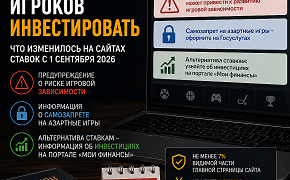
Starting January 1, 2027, a "Self-restriction" tool must be constantly present on the websites and in the mobile applications of organizers.
Moreover, this is not about a barely noticeable link buried in the settings.
The law establishes specific requirements for how prominent this interface element should be.
It must occupy a significant part of the visible area of the page unless the government specifies otherwise.
The idea is simple: opting out of gambling should be quick, clear, and accessible directly from the casino interface.
The operator must not hinder self-restriction
The new rules are not limited to just having the corresponding button.
Once a user selects self-restriction, the operator must not create additional obstacles to complete the procedure.
This means that the mechanism must not turn into a long chain of promotional screens, bonus offers, or attempts to persuade the player to stay.
After confirming self-restriction, the player's participation in gambling must be terminated quickly and within the legally established timeframe.
Self-restriction — for five years
The new mechanism provides for a sufficiently long restriction period.
``````htmlFrom January 1, 2027, a self-restriction statement will mean a ban on participation in the relevant gambling activities for five years.
After this period ends, the restriction may be extended in accordance with the law if the person does not declare its termination.
This makes the Armenian self-restriction system one of the strictest among the markets we have reviewed in the region.
Advertising also ceases after self-restriction
The reform concerns not only access to the gaming account.
Once a person is included in the self-restriction system, the operator is prohibited from continuing to encourage their return to gaming.
In particular, the restrictions may affect:
- bonus offers;
- advertising messages;
- SMS;
- emails;
- push notifications;
- offers through social networks;
- other marketing materials aimed at bringing the player back.
Thus, self-restriction must operate not only at the level of technical access but also at the level of marketing communication.
Restrictions will apply not only to players with problematic behavior
The new policy in Armenia goes beyond the classic model of responsible gaming.
From January 1, 2027, the categories of citizens who may be banned from participating in certain types of gambling will be expanded.
The restrictions will also affect certain categories of state, municipal, and public officials, if this is explicitly provided by law.
In addition, other criteria related to the legal or financial status of a specific person may also apply.
This shows that the state views gambling not only as a licensed business but also as a sphere where access may depend on the status of the player themselves.
Age restrictions and player admission
The legal status of online casinos does not mean that participation is available to everyone.
The operator is obliged to comply with the established legal rules for access to gambling.
This includes:
- age restrictions;
- identity verification;
- accounting for self-restriction;
- restrictions for certain categories of citizens;
- compliance with gaming account requirements;
- verification of payment instruments.
Therefore, the ability to technically create an account does not itself mean that a specific user has the right to participate in all types of gambling.
Armenia and Belarus: two centralized but different models
The Armenian reform partially resembles the Belarusian model, which BET RATING analyzed earlier.
In both countries, the state seeks to gain more complete control over gaming operations, identification, and payments.
However, the architecture of regulation differs.
| Criterion | Armenia | Belarus |
|---|---|---|
| Online casinos | Legal if national requirements are met | Legal through virtual gambling establishments |
| Main vector of reform | Creation of a centralized electronic monitoring system | Strengthening control through KYC, AML, and payment infrastructure |
| Player control | KYC, payment instruments, monitoring, self-restriction | KYC, one account, proprietary cards, self-restriction |
| Next key date | January 1, 2027 | July 1, 2027 |
Armenia and Uzbekistan: both markets are legal but at different stages
Uzbekistan has only recently moved to the practical issuance of the first licenses for online gambling.
Armenia, on the other hand, has a longer history of a regulated online market but is now restructuring the very architecture of control.
| Criterion | Armenia | Uzbekistan |
|---|---|---|
| Status of online casinos | Legal | Legal with a license |
| Market stage | Transition to a new control system | Launch of a new licensed market |
| Main feature | Centralized monitoring | Licenses for risk-based online games |
Armenia, Kyrgyzstan, and Kazakhstan: three more different approaches
If we add Kyrgyzstan and Kazakhstan, the regulatory map becomes even more interesting.
| Country | Online casinos | Model |
|---|---|---|
| 🇦🇲 Armenia | Legal | Licensing + transition to centralized monitoring |
| 🇧🇾 Belarus | Legal | VIZ + KYC + strict control |
| 🇺🇿 Uzbekistan | Legal | New licensing model |
| 🇰🇬 Kyrgyzstan | Regulated | Separate licenses for virtual casinos |
| 🇰🇿 Kazakhstan | Prohibited | Prohibitive model |
Armenia stands out in this context as it not only maintains a legal market but also transitions to deep digital integration of the state with the gaming infrastructure.
The main difference of the Armenian model
Armenia does not ban online casinos.
It seeks to make the legal market as transparent as possible for state monitoring.
This means that the focus shifts from the mere fact of having a license to the continuous monitoring of the operator's activities.
For the player, this means a stricter connection between:
- identity;
- account;
- bank card;
- gaming activity;
- self-restriction;
- legal status.
What the new system means for players
For the average user, the main change lies not in the legality of online casinos itself but in the gradual strengthening of control over participation in gambling.
The regulated market increasingly links together:
- the player's identity;
- their gaming account;
- bank account or card;
- payments made;
- gaming activity;
- winnings;
- restrictions on participation in games.
As a result, the anonymous model, where a person simply registers on a site and starts playing, becomes increasingly incompatible with the regulated Armenian market.
What a regulated operator provides to the player
National regulation does not make gambling risk-free and does not guarantee the player winning.
However, it creates legal and technical requirements that the operator must meet.
For the user, this means:
- identification of the legal entity organizing the game;
- existence of national regulation;
- established rules for operating the gaming account;
- control of payment transactions;
- AML/KYC requirements;
- mechanisms for restricting access to gambling;
- gradual connection of the market to a centralized monitoring system.
At the same time, the license regulates the operator's activities but does not eliminate the risk of losing money.
Licensed and foreign online casinos: what is the difference
| Criterion | Regulated operator in Armenia | ``````htmlForeign platform without Armenian permission |
|---|---|---|
| National permission | Yes | No |
| Armenian regulation | Applies | Not the basis of the operator's activity |
| KYC | Provided by the regulated system | Depends on the foreign jurisdiction and operator's rules |
| Payment instrument verification | Provided by national requirements | Depends on the platform's rules |
| Connection to the Armenian monitoring system | Provided by the new model | No |
| Armenian self-restriction mechanisms | Applied in cases provided by law | Not guaranteed |
| Control by Armenian government bodies | Yes | Limited |
Therefore, the presence of a well-known brand, application, or license from another country does not make a foreign casino a participant in the Armenian regulated market.
Why offshore platforms are a separate category
The internet allows users to see the websites of operators registered in various jurisdictions.
Because of this, it is important to distinguish between two concepts:
«the site is accessible from Armenia»
and
«the operator has the right to operate in the regulated market of Armenia».
These are not the same.
If a platform does not belong to the national regulated segment, the presence of a foreign license should be assessed separately — according to the rules of the jurisdiction that issued it.
2026 is not the endpoint of the reform
It would be incorrect to evaluate the Armenian market solely based on the rules in effect today.
In 2026, an infrastructure is being formed that should change the very principle of control over online gambling.
Therefore, the market is in a transitional phase.
| Period | What is happening |
|---|---|
| 2024 | A new law «On the Regulation of Gaming Activities» is adopted |
| 2025–2026 | The regulatory and technical base of the new system is being formed |
| 2026 | Requirements for identification, payment instruments, and control of gaming accounts are strengthened |
| January 1, 2027 | A new package of requirements comes into effect, including enhanced self-restriction mechanisms and additional restrictions for certain categories of individuals |
What will change from January 1, 2027
The beginning of 2027 is one of the key dates for the further development of the Armenian market.
Already adopted changes provide for the strengthening of responsible gaming mechanisms and access control.
Among the most noticeable innovations:
- a new self-restriction mechanism;
- a more visible and accessible tool for opting out of gaming;
- an extended self-restriction period;
- cessation of advertising communications with self-restricted players;
- expansion of categories of individuals for whom participation in gambling may be restricted;
- deeper integration of operators with the new control system.
Therefore, the article on the regulation of online casinos in Armenia will require updating after the new rules come fully into effect.
What will happen next in the Armenian market
The main question is how quickly the new electronic control infrastructure will be fully deployed.
As the reform is implemented, one can expect:
- deeper identification of players;
- strengthened control over payment operations;
- connection of operators to a unified technological infrastructure;
- expansion of automatic monitoring of gaming activities;
- stricter control over access for restricted categories of individuals;
- strengthened requirements for responsible gaming;
- further separation of regulated and foreign segments.
Thus, Armenia is not moving towards a ban on online gambling.
The main direction is strengthening state control over the legal market.
Armenia could become one of the most technologically controlled markets in the region
If the new model is implemented as intended, the Armenian market could differ significantly from classic licensed jurisdictions.
The reason lies in the depth of integration of gaming platforms with the centralized monitoring system.
The state gains the ability to control not only the legal status of the operator but also a significant part of the digital infrastructure of the gaming process.
For operators, this means higher requirements for technology, compliance, and data handling.
For players — less anonymity, stricter identification, and more mechanisms limiting participation in gambling.
Conclusion
Online casinos in Armenia are legal, but their activities are regulated by the state and require compliance with national rules.
At the same time, 2026 is a transitional year.
Armenia is gradually moving away from a model where the main control tool was a license and is creating a more complex digital system.
The new architecture is built around:
- licensing;
- player identification;
- AML/KYC;
- verification of bank accounts and cards;
- electronic management system;
- monitoring center;
- tracking gaming activity;
- self-restriction;
- restrictions for certain categories of individuals.
The main difference between the Armenian approach and the prohibitive model is that the state does not attempt to eliminate online casinos as a type of activity.
Instead, it seeks to make the legal market as transparent as possible for state control.
2026–2027 could be one of the most important periods for regulating online gambling in modern Armenia.
Frequently Asked Questions
Are online casinos legal in Armenia?
Yes. Organizing internet games with winnings is a licensed activity in Armenia.
To operate in the national regulated market, an operator must comply with Armenian legislation.
Does an online casino need a license?
Yes. Operating in the regulated segment requires the appropriate permission and compliance with state-established requirements.
Can I use someone else's bank card?
A mechanism is provided for verifying the ownership of a bank account or card to the person in whose name the gaming account is opened for regulated operations.
Therefore, using someone else's payment instrument may lead to additional verification or refusal to process the transaction.
Does a foreign license make a casino legal in Armenia?
No. A license from another jurisdiction does not replace Armenian permission and does not make the platform a participant in the national regulated market.
What is a monitoring center?
It is one of the key elements of the new electronic system for managing gaming activities.
It is designed to register, store, and analyze data about players, bets, winnings, gaming products, and other events within the regulated system.
Will the state see gaming operations?
```The new model provides for significantly deeper centralized monitoring of gaming activities.
The system is being created to account for and analyze information related to players, bets, winnings, gaming products, and other operations.
What will change from January 1, 2027?
A new package of requirements related to responsible gaming and restricting access for certain categories of users will come into effect.
This includes strengthening the self-restriction system for players.
How will self-restriction work?
Regulated operators' websites and mobile applications must have a noticeable self-restriction tool.
After confirmation, the operator must stop the person's participation in gambling within the legally stipulated time frame.
For how long can one self-restrict?
The new model provides for self-restriction for a period of five years.
After this period ends, the restriction can be extended in accordance with established procedures if the person does not declare its termination.
Will casinos send advertisements after self-restriction?
The new rules provide for the cessation of marketing communications aimed at bringing back the self-restricted player to gambling.
This may include SMS, emails, push notifications, bonus offers, and other promotional messages.
Can certain categories of citizens be banned from playing?
Yes. From 2027, the list of categories of individuals for whom participation in certain types of gambling may be legally restricted will be expanded.
How does Armenia differ from Kazakhstan?
Kazakhstan prohibits internet casinos.
Armenia, on the other hand, maintains a legal online market but strengthens licensing, identification, and centralized state monitoring.
How does Armenia differ from Belarus?
Both countries are moving towards more centralized control of online gambling.
Belarus uses a model of virtual gambling establishments and the SKKS, while Armenia is creating its own electronic management system and monitoring center.
How to check an online casino before registration?
It is necessary to check the legal entity managing the platform, its license for the relevant type of activity, the validity of the license, and the rules for payments and player identification.
BET RATING will continue to monitor the Armenian market
The editorial team of BET RATING will track the implementation of the new monitoring system, changes in legislation, new requirements for operators, and rules for players.
Particular attention will be paid to changes coming into effect on January 1, 2027, as well as the launch of a centralized electronic control infrastructure.
This material will be updated as market rules change.

















































































Comments 0
Please log in on the site, чтобы добавить комментарий, лайк или дизлайк.