

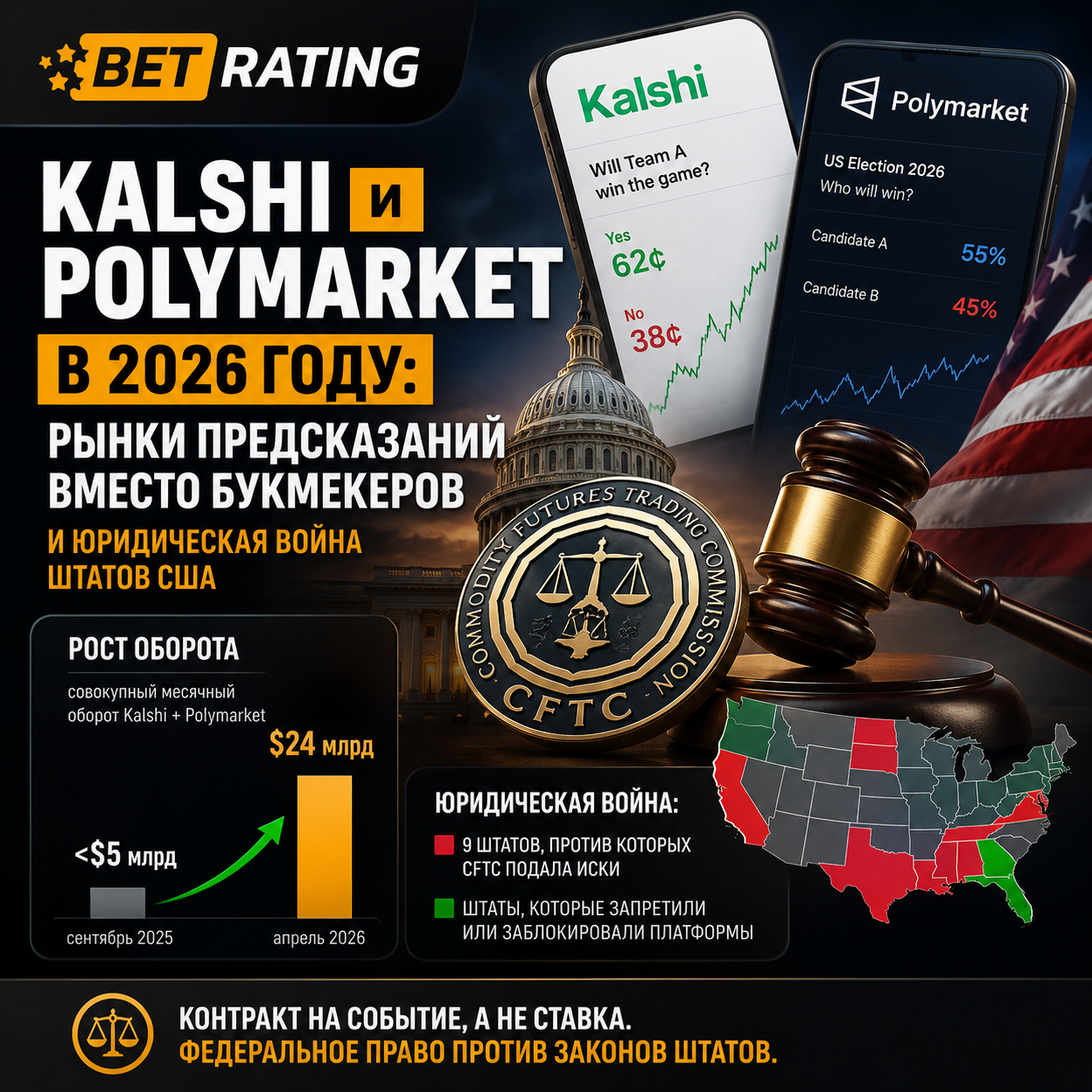
The CFTC considers them as exchanges for regulated derivatives — event contracts. Several U.S. states believe that sports contracts on these platforms effectively constitute gambling. In terms of sports money, they are already competitors to traditional bookmakers, leading the federal regulator to sue nine states simultaneously.
If in 2026 you saw ads for Kalshi during the NHL playoffs or encountered discussions about Polymarket in the crypto community but didn't fully understand how it differs from regular sports betting — you are not alone. This is precisely the question that several U.S. state courts, regulators, and, reportedly, in the future — the Supreme Court, are currently addressing.
We explore what prediction markets are, why they are not legally considered gambling at the federal level, where the explosive growth in turnover came from, and why nine U.S. states are currently suing the federal regulator specifically over sports contracts on these platforms.
In Brief
| Question | Answer |
|---|---|
| What is it formally | Regulated derivatives (event contracts) according to the CFTC; states dispute |
| Who regulates at the federal level | CFTC — Commodity Futures Trading Commission |
| Share of sports in Kalshi's turnover | ≈80% of total trading volume |
| Share of sports in Polymarket's turnover | ≈39% |
| Growth in turnover (Kalshi + Polymarket) | From <$5 billion (Sept. 2025) to $24 billion per month (Apr. 2026) |
| Is it legal in all 50 states | CFTC insists on federal regulatory priority, but individual states dispute the availability of sports contracts |
| Number of states against which the CFTC has filed lawsuits | 9 (Arizona, Connecticut, Illinois, Kentucky, Minnesota, New Mexico, New York, Rhode Island, Wisconsin) |
| Proposed new CFTC rules | NPRM published on June 10, 2026, undergoing review process |
What is a prediction market
Kalshi and Polymarket do not consider themselves bookmakers. The CFTC views their products as regulated derivatives — event contracts — under the federal Commodity Exchange Act, the same law that regulates commodity and financial futures. However, this is not a closed question: the CFTC itself proposed rules in June 2026 that separately define the term "gaming" in relation to event contracts and assess whether specific sports contracts fall under categories that require separate permission by law. Meanwhile, several states insist that sports contracts on these platforms are essentially gambling, which should be subject to state gambling laws rather than federal exchange laws.
From a user perspective, the difference on the phone screen is almost imperceptible: you open the app, select the likely outcome of an event (for example, "Team A will win the match"), and invest money in a contract that will increase or become worthless depending on the result. But the legal structure that the CFTC advocates is fundamentally different.
- The player bets money against the bookmaker at a fixed odds
- The bookmaker acts as the counterparty to each bet
- Regulated by state gambling laws
- The odds are set by the bookmaker based on their model
- The trader buys or sells a contract to another trader on the exchange
- The platform acts as an exchange, not a party to the transaction
- Regulated by the federal Commodity Exchange Act through the CFTC
- The price of the contract is determined by the market — supply and demand among the traders themselves
Where the explosive growth came from
According to a Pew Research Center study, the combined monthly turnover of Kalshi and Polymarket increased more than fourfold in just eight months — from less than $5 billion in September 2025 to $24 billion in April 2026.
Sports emerged as the main driver of this growth. Since July 2024, sports contracts accounted for about 80% of the total trading volume on Kalshi — comparable to what one might see with a traditional bookmaker. On Polymarket, the share of sports is more modest — around 39%, but it remains the largest separate category of contracts on the platform.
How Polymarket made its return to the U.S.
For a long time, Polymarket could not legally operate with American users: in 2022, the CFTC forced the platform to block access for the U.S. following an investigation. The situation changed in July 2025 when Polymarket acquired QCEX — a CFTC-licensed exchange and clearinghouse — for $112 million. In September 2025, the CFTC issued a technical approval (no-action letter), and in November 2025, full approval (Amended Order of Designation), allowing the platform to officially return to the U.S. market under the new brand Polymarket US.
Legal war of states against the federal regulator
Formal federal legality has not stopped several states from attempting to block Kalshi and Polymarket on their own, citing local gambling laws. In response, the CFTC is filing counterclaims, defending the exclusive right of the federal regulator to determine the fate of these platforms.
```htmlThe situation is not uniform. In April 2026, the New Jersey appellate court sided with Kalshi and prohibited state authorities from blocking the platform. Conversely, a federal judge in Minnesota overturned a potential statewide ban on prediction markets. In Arizona, the case escalated to an attempt to bring criminal charges against Kalshi for violating local election gambling laws — the CFTC filed a counterclaim and secured a temporary injunction against such prosecution, although not all appeals in this case have been exhausted.
What the regulator proposes to change
On June 10, 2026, the CFTC published a draft of new rules for prediction markets (NPRM) — the document is undergoing an official review process. According to ESPN, which covered the contents of the draft, the proposed approach is as follows:
- Allow Most contracts on the outcomes of sporting events — according to the CFTC, they promote "price discovery" and do not contradict public interests.
- Prohibit According to ESPN — contracts vulnerable to manipulation: bets on specific players' injuries, referee decisions, and other narrow in-game events.
Overall, the CFTC document formulates a broader task: to determine which event contracts fall under the concept of "gaming" and other legislatively enumerated categories that require separate regulatory scrutiny.
A separate and more recent story — the so-called "mention markets": contracts on whether a specific person will say a certain word during a public speech, on an investor call, or in television and radio broadcasts. In August 2026, the CFTC began an internal review of such contracts; Kalshi had already removed sports mention contracts shortly after receiving notification from the regulator about the start of the review.
Not just courts: banks and legal operators are also concerned
Regulatory pressure is not only affecting states. According to the Financial Times, JPMorgan closed Polymarket's accounts last year. A group of Democrats in Congress, led by Senator Jeff Merkley, sent a letter to the CFTC urging it to tighten regulations and combat the "erosion of integrity" in prediction markets. Representatives of the tribal gaming business in California claim that sports contracts violate federal law regulating tribal gaming (IGRA) as they compete with their licensed casinos, bypassing agreements with the state.
Prediction markets vs traditional online gambling: the numbers
According to TRM Labs, an analytical company specializing in blockchain monitoring, the volume of on-chain prediction markets in the first quarter of 2026 surpassed the volume of on-chain gambling for the first time: $36.6 billion compared to a comparably smaller amount for traditional crypto gambling platforms. For comparison, in 2025, these two segments were roughly equal — about $51 billion and $54 billion, respectively.
What this means for players outside the U.S.
Right now, prediction markets in their regulated federal form are a specifically American story: both Kalshi and Polymarket US operate under licenses from the CFTC. However, the model itself is already attracting interest worldwide precisely because it formally circumvents traditional gambling regulation, rather than finding a way to comply with it.
What will happen next
- what will be the outcome of the 45-day consultation period on the proposed CFTC rules;
- whether the U.S. Supreme Court will take up the case regarding the delineation of powers between the federal regulator and the states;
- how the CFTC's review of "mention markets" will develop;
- whether the list of states suing the CFTC will expand or, conversely, begin to shrink following initial court decisions;
- how major traditional betting companies will respond to the competition — major market operators are already monitoring this model as a potential threat or partner.
Conclusion
Kalshi and Polymarket in 2026 are not a niche experiment but an industry with a turnover of tens of billions of dollars per month, where sports make up a large part of the traffic. The CFTC views their products as regulated derivatives — event contracts subject to the federal Commodity Exchange Act, rather than state gambling laws.
But this is not a closed question: the CFTC itself proposed rules in June 2026 that separately address which event contracts actually fall under the category of "gaming." And nine states are directly contesting the federal position in courts, insisting that sports contracts are gambling that requires state-level regulation. Some courts support the federal position, while others support the states' position, and the dispute, according to the former CFTC chairman, may ultimately reach the Supreme Court.
For the online betting industry as a whole, this may be the most significant structural challenge in recent years: not a new licensing law, but an open dispute about what constitutes gambling in a world where a bet can be legally repackaged as an exchange contract.
Frequently Asked Questions
What are Kalshi and Polymarket?
```These are the platforms that the CFTC considers as exchanges for regulated derivatives—event contracts—rather than as sportsbooks. Some U.S. states dispute this classification concerning sports contracts.
Are Kalshi and Polymarket legal in the U.S.?
The CFTC insists on federal regulatory priority and legality across all 50 states. However, several states view sports contracts as gambling and are attempting to apply their own gaming laws to the platforms, leading to legal disputes.
How does an event contract differ from a bet with a bookmaker?
When betting, a player wagers directly with the bookmaker at a fixed odds. When purchasing an event contract, a trader trades with other traders on an exchange. The CFTC classifies this as an exchange instrument under the Commodity Exchange Act; critics argue that this structure is a disguised form of sports betting.
How much did prediction markets grow in 2026?
According to the Pew Research Center, the combined monthly turnover of Kalshi and Polymarket increased more than fourfold over eight months—from less than $5 billion in September 2025 to $24 billion in April 2026.
Why are states suing the CFTC over Kalshi and Polymarket?
Nine states (Arizona, Connecticut, Illinois, Kentucky, Minnesota, New Mexico, New York, Rhode Island, and Wisconsin) believe that sports contracts on these platforms are effectively gambling and should be regulated at the state level. The CFTC is contesting this in court, insisting on federal priority.
Can the U.S. Supreme Court hear this dispute?
According to former CFTC Chairman Gary Gensler, the issue of delineating the powers of the federal regulator and the states in this area could eventually reach the Supreme Court.
What types of bets does the CFTC want to ban?
The proposed rules from June 10, 2026, outline which event contracts fall under the category of "gaming." According to reports from ESPN, restrictions are being discussed for contracts vulnerable to manipulation—such as bets on player injuries or referee decisions, while allowing contracts on overall event outcomes.
Do Kalshi and Polymarket operate outside the U.S.?
The CFTC's position on the status of event contracts is specific to U.S. federal law. In most other jurisdictions, including CIS countries, similar activities are likely subject to standard gambling regulations.
Sources
- Pew Research Center—data on the growth of Kalshi and Polymarket, April 2026
- ESPN, CNBC—materials on proposed CFTC rules, June 2026
- CBS Sports, CBS News—legal status of prediction markets by state, August 2026
- Congressional Research Service (CRS)—"Prediction Markets: Policy Issues for Congress," March 2026
- TRM Labs—comparison of on-chain prediction markets and gambling volumes, 2026
- CoinDesk, Axios, Sportico—chronicle of Polymarket's return to the U.S. market, 2025
This material has been prepared by BET RATING based on CFTC materials, industry publications, and analytical reports as of August 2026. The legal status of prediction markets in individual U.S. states continues to evolve as court decisions and regulatory changes occur.
Trading event contracts, like any form of betting and investment, involves the risk of financial loss.





























































































































Comments 0
Please log in on the site, чтобы добавить комментарий, лайк или дизлайк.