

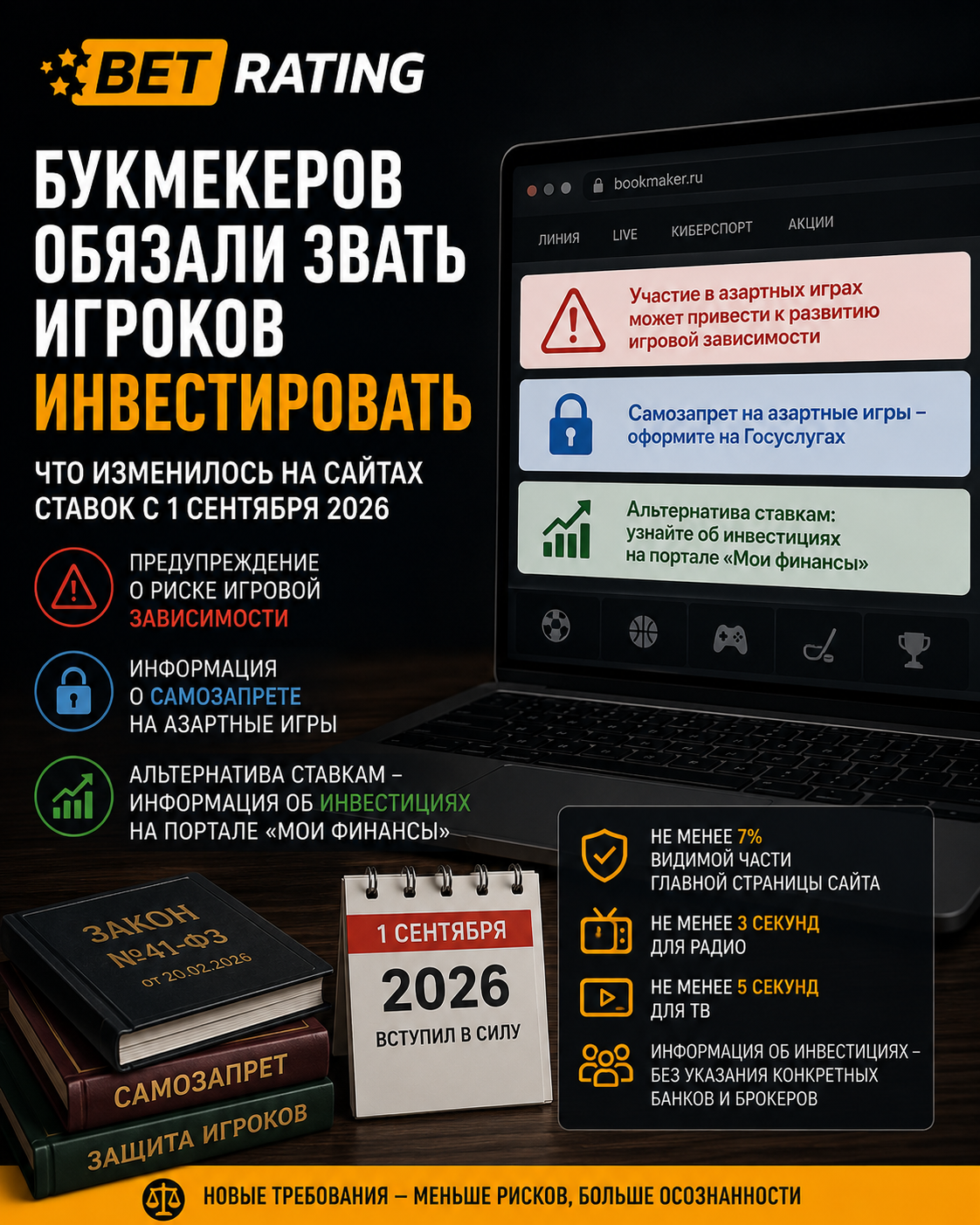
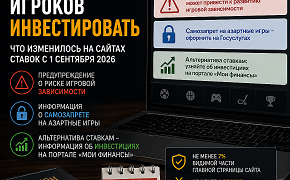
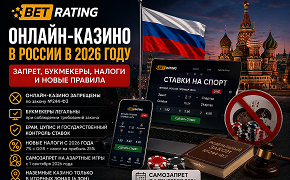
Starting from September 1, new mandatory warnings about the risks of gambling, information about the state self-exclusion, and links to alternative financial instruments appeared simultaneously on the websites of Russian bookmakers. The most unusual part of the new requirements is the suggestion to learn about investments instead of betting.
This year, we have been analyzing the regulation of the Russian betting market in parts: self-exclusion, penalties for violations, tax reform, and the proposed legalization of online casinos. On September 1, 2026, several of these changes materialized literally on the user's screen — in the form of mandatory banners that everyone sees when visiting a legal bookmaker's website.
We will explore what these banners are, where the idea of inviting players to invest instead of betting came from, how the bill changed on its way to adoption, and what the industry is already saying about it.
In Brief
| Question | Answer |
|---|---|
| Federal Law | No. 41-FZ dated 20.02.2026 |
| Bill Number | No. 981492-8, government |
| Effective Date | September 1, 2026 |
| What is now on bookmaker websites | Warning about risks, information about self-exclusion and investments |
| Where does the information about investments lead | To the "My Finances" portal |
| Warning on the website | At least 7% of the visible part of the main page |
| Requirement for radio / TV advertising | At least 3 and 5 seconds respectively |
| Who regulates the investment block design | Ministry of Finance |
| Can specific banks/brokers be named in the banner | No, the information must be anonymized |
What Exactly Bookmakers Are Now Required to Show
According to Federal Law No. 41-FZ dated February 20, 2026 (adopted based on government bill No. 981492-8), bookmakers are required to place information on their websites about the risks and possible consequences of participating in gambling, as well as to provide access to information about financial services for investing spare money — with the aim of preserving it or earning additional income. QR codes leading to a page with such information must appear at betting points and offices. At the same time, it should not refer to specific individuals providing banking, insurance, or financial services — the content and design of these blocks are regulated by the Ministry of Finance.
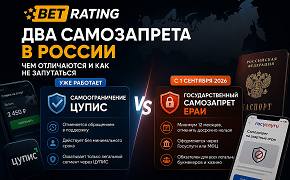
The requirement for self-exclusion is formally regulated by a separate law — No. 575-FZ, which we discussed in the article about the difference between TSUPIS and the state register ERAI. However, in practice, as noted by Sports.ru, both requirements came into effect on the same date — September 1, 2026 — so the user sees all three information blocks on the website simultaneously, even though formally these are two different legislative changes.
According to industry experts, by the beginning of September 2026, such blocks had already appeared on the websites of the largest bookmakers.
Where the Idea of Inviting Players to Invest Came From
The idea was publicly explained by the head of the State Duma's Financial Market Committee, Anatoly Aksakov, during the discussion of the bill. According to him, a significant portion of bookmaker clients are people prone to gambling addiction and losing substantial amounts, but among them are also those who would like to invest in company stocks but simply do not know about such an opportunity.
The authors' logic is not to ban betting but to offer a visible alternative for that part of the audience that is looking for a way to earn or preserve money but has chosen betting simply by default.
How the Bill Was Softened on Its Way
The wording of the final law differs significantly from the initial version. By the second reading, deputies made several amendments.
of the visible part of the main page for the warning
The wording of the warning itself also changed: instead of directly indicating "the risk of losing money and harm to health," the final text established a softer version — about "the possibility of developing gambling addiction." Additionally, the State Duma Committee on Economic Policy proposed on February 6, 2026, to postpone the law's entry into force by six months — this is how the final date became September 1, 2026, instead of an earlier deadline.
Timeline
- November 2025The idea of investment banners is publicly discussed at the level of the State Duma's Financial Market Committee.
- End of October 2025The State Duma adopts the bill in the first reading, obliging gambling organizers to warn clients about risks.
- February 6, 2026The State Duma Committee on Economic Policy proposes to move the law's effective date to September 1, 2026; the wording of the warning is softened, and the required area for the warning on the main page of the site is reduced from 10% to 7%.
- February 10, 2026The bill is considered in the second reading.
- September 1, 2026The law comes into force; banners about addiction, self-exclusion, and investments appear on bookmaker websites.
What the Industry Is Already Saying
Initial practical assessments of the placement of banners appeared almost immediately after the law came into effect. Betting expert Vladimir Prokofiev noted that the best placement of mandatory banners about self-limitation and investments is currently represented by the top 5 bookmakers.
This assessment is indicative: from the industry's perspective, a "good" solution is considered one that minimally distracts the user from the main function of the site—viewing odds and placing bets—rather than the most noticeable warning that the authors of the law anticipated.
Context: Why This Became a Subject of Regulation
The legislators' argument was based on the rapid growth of the betting market's revenue: from 879 billion rubles in 2022 to 1.22 trillion in 2023 and 1.73 trillion rubles in 2024. Against the backdrop of this growth, the government is simultaneously introducing several different mechanisms to protect players—not only banners but also self-exclusion, which we wrote about earlier.
What Will Happen Next
- Will the Ministry of Finance change the requirements for the design of investment blocks based on the first months of practice;
- Will there be statistics on how many users actually click on QR codes and banners leading to the "My Finances" portal;
- Will bookmakers maintain minimalist banner placements, or will the regulator demand more noticeable designs;
- How will this measure relate to the already existing self-exclusion and the discussed legalization of online casinos.
Conclusion
As of September 1, 2026, the websites of Russian bookmakers simultaneously implemented the requirements of two laws: a warning about the risk of gambling addiction and access to investment information under law No. 41-FZ, as well as information about self-exclusion under a separate law No. 575-FZ. The required area for warnings on the main page of the site was reduced from the initial 10% to 7%, and the wording was softened from "risk of losing money and harm to health" to "possibility of gambling addiction arising."
It is still too early to judge whether this will change the actual behavior of players—but the mere fact of the presence of an investment offer alongside the bet shows that the government is trying to address the problem of gambling addiction not only through bans and fines but also through a visible alternative offered by some.
Frequently Asked Questions
What banners are bookmakers now required to display?
About the risk of gambling addiction, the possibility of self-exclusion through "Gosuslugi," and alternative ways to invest money through the "My Finances" portal.
From what date does the new law on banners take effect?
From September 1, 2026.
What area should the warning about risks occupy?
At least 7% of the visible part of the main page of the bookmaker's or totalizator's site; for advertising on radio and TV—at least 3 and 5 seconds, respectively.
Can a specific bank or broker be named in the investment banner?
No, the information must be anonymized and not refer to specific financial service providers; the content and design of the block are regulated by the Ministry of Finance.
Why was the warning area requirement reduced from 10% to 7%?
The wording was softened for the second reading of the bill in February 2026—along with the postponement of the law's entry into force by six months, until September 1.
Who proposed the idea of inviting players to invest?
The idea was publicly promoted by the head of the State Duma's Committee on the Financial Market, Anatoly Aksakov, explaining that some bookmaker clients would like to invest but are unaware of such an opportunity.
How does the industry assess the new requirements?
Initial industry assessments consider the "best" placement to be one where banners minimally distract the user—for example, hidden behind a separate button or placed in an additional section of the site.
Are betting points also required to display this information?
Yes, QR codes linking to the page with information about financial services for investment must be placed at the entrance to betting points and offices.
Sources
- «Interfax» — «The Duma softened the bill on bookmakers' obligation to advertise alternatives to betting,» February 6, 2026
- Sports.ru (betting industry) — «Banners about gambling risks, self-restriction, and investment opportunities have appeared on bookmakers' websites,» September 2026
- Sports.ru — comment by Vladimir Prokofyev on banner placement, September 2026
- RBC Investments — «Bookmaker players will be invited to invest,» November 2025
- «Parliamentary Newspaper» — comments on the bill, November 2025
- State Duma Bill Database — bill No. 981492-8
This material was prepared by BET RATING based on publications from Russian media and the State Duma bill database as of September 2026. Requirements for the design of informational blocks may be clarified by the Ministry of Finance.
Gambling is associated with the risk of losing money and can lead to addiction. Investments are also associated with the risk of losing invested funds and are not a guaranteed way to earn money.













































Comments 0
Please log in on the site, чтобы добавить комментарий, лайк или дизлайк.