

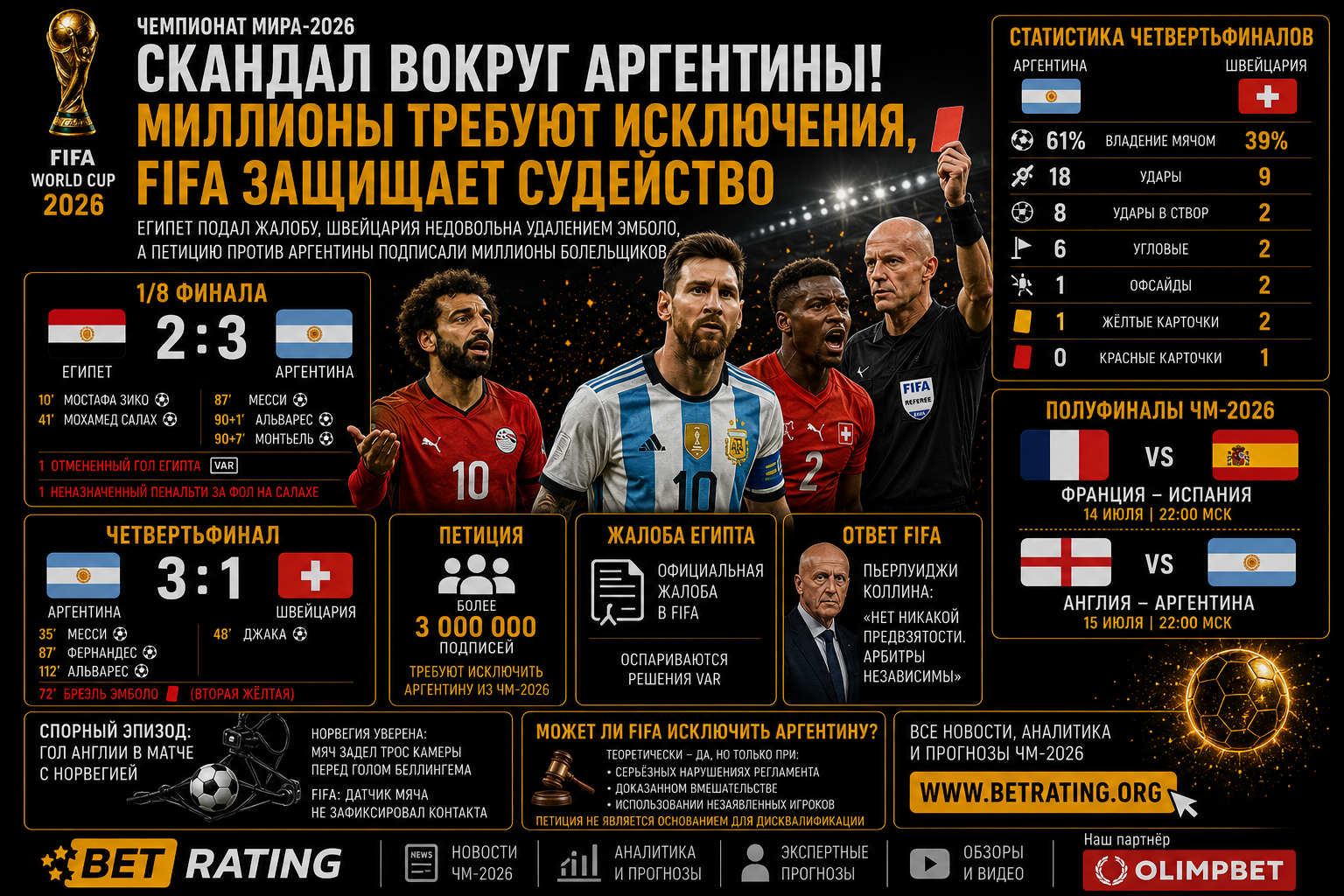
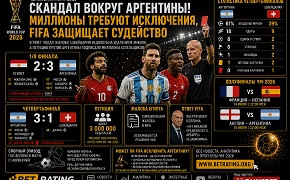
Before the semifinals of the 2026 World Cup, not only the players but also the referees are in the spotlight. An online petition demanding the exclusion of Argentina from the tournament has gained popularity, Egypt has officially complained to FIFA after their loss in the Round of 16, and Switzerland has sharply criticized the red card given to Breel Embolo in the quarterfinals.
Despite the loud statements and widespread discussion, Argentina remains a participant in the 2026 World Cup and is preparing for the semifinal against England. FIFA has not announced the start of the procedure to exclude the team, and the head of the refereeing body, Pierluigi Collina, rejected accusations that the referees are intentionally helping Lionel Messi and the reigning world champions.
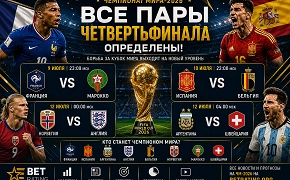
Despite the public outcry, the semifinal bracket of the World Cup remains unchanged. Current odds for the matches France — Spain and England — Argentina, the path to the final, totals, spreads, and tournament winner are presented on Olimpbet.kz .
This material is for informational purposes only. Betting involves financial risk. Please adhere to age restrictions and gamble responsibly.
What's Happening Around the Argentina National Team
| Event | What Happened | Current Status |
|---|---|---|
| Petition Against Argentina | The authors accuse FIFA and the referees of favoritism towards Argentina and demand the team's exclusion | Private online campaign |
| Egypt's Complaint | The Egyptian Federation contested VAR decisions after losing 2:3 | Complaint submitted to FIFA |
| FIFA's Response | Pierluigi Collina defended the referees' decisions and rejected accusations of bias | Match result not reviewed |
| Embolo's Red Card | Switzerland was left with ten players at a score of 1:1 | Decision upheld |
Why the Petition Against Argentina Emerged
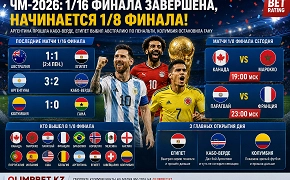
The main reason for the widespread discontent was the Round of 16 match between Argentina and Egypt. The African team was leading 2:0 and was just minutes away from one of the biggest upsets in World Cup history.
Argentina managed to make a comeback and won 3:2, scoring three goals in the closing stages of the match. However, after the final whistle, the discussion quickly shifted to the referees' performance.
The Egyptian side was dissatisfied with the disallowed goal that could have increased their lead and the incident involving a possible foul on Mohamed Salah before Argentina's winning attack.
Accusations arose on social media that FIFA was allegedly interested in furthering Lionel Messi's progress in the tournament.
It was on this wave that a website was created calling for Argentina's exclusion from the 2026 World Cup. The campaign's authors claim that millions of people supported the petition.
The petition is not an official appeal to FIFA's disciplinary body. Even several million signatures alone cannot lead to the exclusion of a team from the World Cup.
Over Three Million Signatures: Can the Figure Be Trusted?
A number of sports publications reported that the number of participants in the campaign exceeded three million.
However, the main website of the initiative is an independent platform. Its counter is not linked to FIFA, national federations, or any international petition verification system.
On other platforms, there are separate petitions with the same demand, but the number of signatures on them varies significantly.
Therefore, the correct formulation is as follows: the campaign organizers claim millions of supporters, but there is no official confirmation of this figure from an independent body.
This does not negate the scale of the discussion. The topic has indeed gone far beyond the fans of Egypt and has become one of the main news stories leading up to the semifinals.
What Exactly Egypt Is Contesting
The Egyptian Football Association has submitted an official complaint to FIFA regarding the refereeing in the match against Argentina.
The first disputed incident was related to the disallowed goal by Mostafa Ziko. After reviewing VAR, the referees identified a foul at the start of the attack.
The Egyptians believed that the contact was not sufficient grounds for disallowing the goal. Had the goal stood, the advantage for the team could have been significantly greater.
The second incident occurred at the end of the match. Egyptian representatives demanded a penalty after contact with Mohamed Salah.
The referee continued the game, and soon Argentina organized an attack that resulted in the winning goal.
Why the Egyptian Side Spoke of Injustice
The defeat was particularly painful for Egypt. The team was leading 2:0 and was one step away from a historic quarterfinal appearance.
Head coach Hossam Hassan stated after the match that he would no longer watch the World Cup. He linked the loss to the unfair decisions of the referees.
The emotions of the Egyptian side are understandable. When a team loses after such a lead, every controversial decision is perceived much more acutely.
However, the existence of a complaint does not automatically imply an acknowledgment of a refereeing error. FIFA must separately assess each incident and the referees' actions.
FIFA's Response: Collina Rejected Accusations of Bias
The head of FIFA's refereeing body, Pierluigi Collina, publicly commented on Egypt's complaints.
He rejected claims that the refereeing team could have acted in favor of Argentina or Lionel Messi.
According to FIFA, in the incident with the disallowed goal, VAR correctly identified a foul at the start of the attack.
The contact with Salah at the end was assessed as normal gameplay, insufficient for a penalty to be awarded.
Collina also emphasized the independence of the referees and stated that accusations of intentional influence on the outcome could create a dangerous atmosphere around refereeing.
Why FIFA's Response Did Not Stop the Controversy
The official explanation did not convince some fans. Many believe that the problem lies not only in specific incidents but also in the overall inconsistency of VAR decisions.
The same contact in different matches can receive different evaluations. In one case, the referee continues the game, while in another, the video assistant intervenes.
It is precisely the lack of a clear and consistent refereeing line that creates the ground for discussions about favoritism.
At the same time, there has been no evidence published that FIFA actually organized the promotion of Argentina.
There is a significant difference between a controversial refereeing decision and proven collusion. In public discourse, these concepts are often conflated.
A New Scandal: Embolo's Red Card in the Match Against Switzerland
After the match against Egypt, the discussion did not end. In the quarterfinals, Argentina faced Switzerland and was once again at the center of a refereeing controversy.
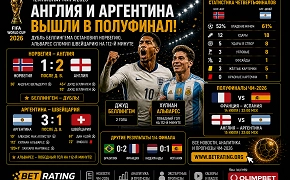
With the score at 1:1, Breel Embolo received a second yellow card for simulation and was sent off.
The referee initially assessed the incident differently, but after VAR intervention, the decision was changed.
Switzerland was left with ten players and had to defend for almost 50 minutes, including extra time.
Argentina scored the winning goal in the 112th minute and then established the final score — 3:1.
Why Switzerland Called the Decision Unacceptable
Head coach Murat Yakin sharply criticized the interpretation of the incident.
In his opinion, the contact did not warrant a second yellow card, and the VAR intervention had a direct impact on the outcome of the quarterfinal.
Swiss players also demanded explanations. The team had just equalized and felt capable of imposing an open game on Argentina.
After the red card, the entire scenario changed. Switzerland had to abandon their attacking plan and focus on defense.
Argentina gained a numerical advantage immediately after Switzerland equalized and seized the emotional initiative.
Does Two Scandals Mean Argentina Is Really Being Helped?
Two consecutive matches with loud refereeing controversies look suspicious to opposing fans.
Egypt believes that VAR decisions deprived the team of a historic victory. Switzerland is convinced that Embolo's red card broke the balance of the quarterfinal.
However, to draw a conclusion about intentional favoritism, evidence of systemic influence on referees is needed.
So far, complaints, emotional statements, and controversial interpretations of incidents have been published, but not evidence of collusion.
That is why it is incorrect to speak of a "bought tournament" or a predetermined winner.
A more accurate formulation is: the refereeing in Argentina's matches has caused serious public outcry and requires maximally transparent explanations.
Can FIFA Exclude Argentina from the 2026 World Cup?
Theoretically, FIFA can exclude a team from the tournament, but specific grounds are necessary for this.
These can include serious violations of regulations, the use of a player without eligibility, interference by the federation in match results, or proven corruption.
A refereeing error alone usually does not lead to the exclusion of a team that benefited from the decision.
Even if FIFA acknowledges a refereeing error, the match result almost always stands.
The online petition is also not a legal basis for disqualification.
At the time of preparing this material, Argentina officially remains a participant in the semifinal.
What Needs to Happen for Real Exclusion
| Possible Grounds | Is It Enough for Exclusion? | Current Situation |
|---|---|---|
| Mass Petition | No | Public initiative |
| Controversial VAR Decisions | Usually no | FIFA defends referees' decisions |
| Official Complaint from Egypt | Not automatically | Complaint submitted |
| Proven Collusion | Potentially yes | No public evidence |
Why the Topic Became So Popular
Argentina is the reigning world champion, and Lionel Messi remains the main symbol of the tournament.
Any decision in favor of such a team receives significantly more attention than a similar episode in a match involving less publicized teams.
Moreover, Messi continues to fight for a second consecutive title. For some fans, this is a great sports story; for others, it is too perfect a scenario that raises suspicions.
The mass dissemination of short videos also amplifies the effect. One episode is shown without full context, quickly turning it into evidence of a predetermined narrative.
As a result, a sports dispute transforms into a global theory about FIFA's influence on the outcome of the World Cup.
How Argentina Itself Is Reacting
Representatives of the Argentine national team reject accusations of refereeing favoritism.
Defender Lisandro Martinez stated that the referees are doing well in the tournament, and the team is focusing solely on football.
For Argentina, the main argument lies on the field: the team came back from 0:2 against Egypt and defeated Switzerland after a grueling extra time.
From the players' perspective, discussions about referees' assistance undermine the character of the team and the players' actions in crucial moments.
England — Argentina: The Scandalous Background Before the Semifinal
The semifinal England — Argentina was already one of the main highlights of the tournament even without the scandal.
Now the referees' performance will be under maximum scrutiny. Any controversial decision in favor of Argentina could trigger a new wave of accusations.
English fans are already discussing episodes from the matches against Egypt and Switzerland, fearing a repeat of the controversial scenario.
For FIFA, this is a serious test. The refereeing team must not only conduct the match well but also explain VAR interventions as clearly as possible.
Why the Semifinal Will Be Especially Challenging for Referees
England and Argentina have players who often come into contact inside the penalty area.
Bellingham regularly joins from deep and finds himself between defenders. Messi and Alvarez are constantly looking for space at the edge of the box.
In such a match, controversial falls, collisions, and checks for possible handballs are almost inevitable.
Any lengthy VAR pause will be viewed through the lens of previous scandals.
The main task for the referees is to assess contacts equally at both ends.
What to Consider Before Betting on England — Argentina
The scandalous background should not completely dictate the sports forecast.
England approaches the match after a 2:1 victory over Norway in extra time. Jude Bellingham scored a brace and became the main hero of the quarterfinal.
Argentina also played 120 minutes. The team defeated Switzerland 3:1 but struggled to capitalize on their numerical advantage for a long time.
Markets for the main outcome, passage to the final, totals, spreads, both teams to score, and individual player statistics are available on Olimpbet.kz .
Before choosing a prediction, it is important to wait for information about the refereeing team's composition, starting lineups, and player conditions after extra time.
BET RATING Prediction
Controversial decisions in previous matches do not negate the fact that Argentina remains one of the strongest teams in the tournament.
The reigning champions have significant experience in knockout matches and know how to maintain focus in tense endings.
England has a deeper squad and has Bellingham in excellent form.
The semifinal is likely to be cautious. Both teams have played 120 minutes and will understand the cost of the first mistake.
A slight advantage can be given to Argentina due to experience, but England is capable of creating serious problems through physical strength and midfield involvement.
Refereeing will be discussed regardless of the outcome, but the sports result will primarily be determined by the quality of play and the conversion of chances.
FAQ: Petition Against Argentina and Refereeing Scandal
Do they really want to exclude Argentina from the 2026 World Cup?
An online petition has been created with such a demand. However, it is a private public initiative, not a decision by FIFA.
How many people have signed the petition?
Organizers and some sports publications report more than three million supporters. There is no independent official confirmation of the counter.
Why did Egypt complain about the refereeing?
The Egyptian federation contested a disallowed goal and a non-awarded penalty in the Round of 16 match against Argentina.
What did FIFA respond?
Pierluigi Collina defended the referees' decisions and rejected accusations of bias.
Why was Breel Embolo sent off?
The Swiss forward received a second yellow card for simulation after VAR intervention.
Can the petition lead to Argentina's exclusion?
No. Officially proven regulatory violations are necessary for exclusion, not just public demand.
Is there evidence that FIFA is helping Argentina?
No public evidence of collusion or intentional promotion of the national team has been presented.
Will the England — Argentina semifinal take place?
Yes. At the time of preparing this material, the match remains on the official schedule of the 2026 World Cup.
When will England and Argentina play?
The semifinal will take place on July 15, 2026, at 22:00 Moscow time.
Conclusion
Argentina has reached the semifinals of the 2026 World Cup amid the largest refereeing scandal of the tournament.
Egypt has officially complained to FIFA, Switzerland criticized Embolo's red card, and organizers of the online campaign claim millions of signatures for the exclusion of the reigning world champions.
Meanwhile, FIFA defends the referees' work, and there is no public evidence of collusion. Argentina remains a participant in the World Cup and is preparing for the semifinal against England.
Stay updated with the latest news, analysis, and predictions at BET RATING , and check the current odds for the 2026 World Cup at Olimpbet.kz .










































































Comments 0
Please log in on the site, чтобы добавить комментарий, лайк или дизлайк.