

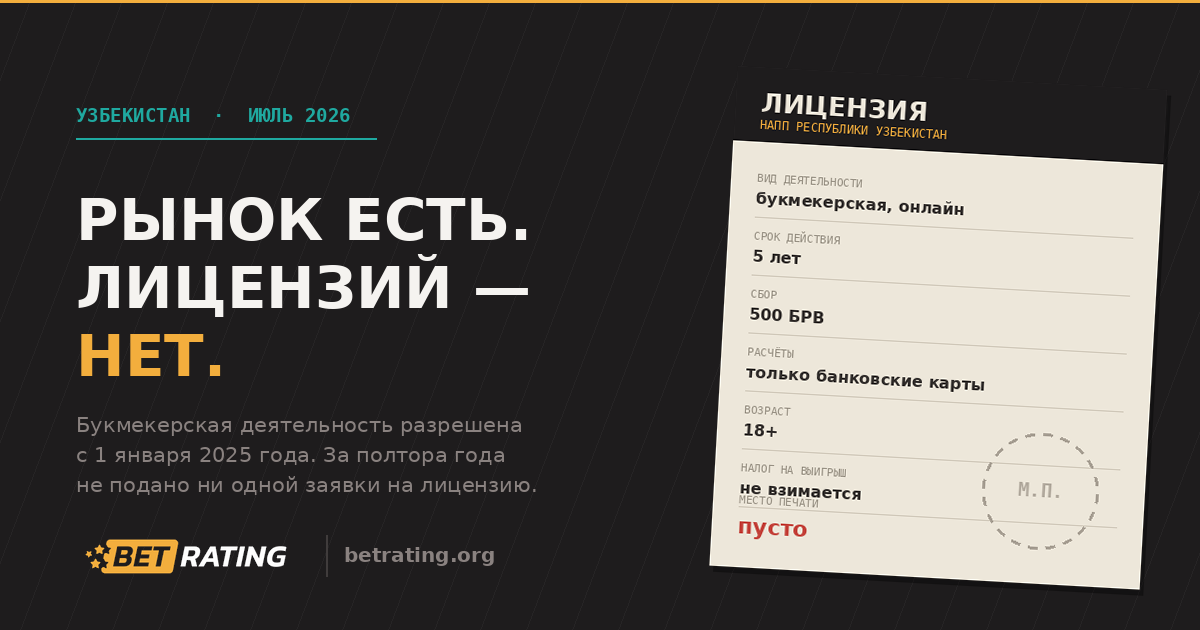
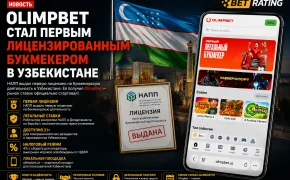
Briefly about the main points: Uzbekistan has undergone a rare path for the region — from a complete ban on gambling to its legalization. As of January 1, 2025, online betting activities are officially permitted. However, by mid-2026, there are no licensed operators in the market: no applications for licenses have been submitted. We analyze why the legal market exists only on paper, what is written in the law, and what this means for the average person.
From prohibition to legalization: a brief chronicle
The history of Uzbek betting is a nearly twenty-year circle that has come full circle.
Until 2005 betting shops operated in the country. From September 1, 2007 the organization and conduct of gambling and risk-based games, including totalizators, were banned. Exceptions were made only for lottery draws, instant lotteries, and numerical lotteries. Subsequently, changes were made to the Criminal and Administrative Codes: liability was established for organizing such games and for participating in them.
2019 — The Ministry of Sports Development publicly raises the issue of returning bookmakers for the first time.
2020 — The president signs a decree on the development of football, which proposed to allow licensed betting activities starting January 1, 2021. Part of the operators' income was to be directed towards sports development. However, the reform did not materialize.
April 2024 — Shavkat Mirziyoyev signs a decree to improve the regulation of lotteries and risk-based games. This document stipulated that from January 1, 2025, the organization of online games and betting activities would be permitted based on licenses.
December 2024 — The Cabinet of Ministers approves a resolution with a specific procedure for organizing betting activities.
July 2025 — NAPP approves the Licensing Regulations and the list of categories of citizens prohibited from participating in betting.
On paper — a comprehensive, systematically structured reform. In practice — a pause that continues to this day.
What exactly the law has permitted
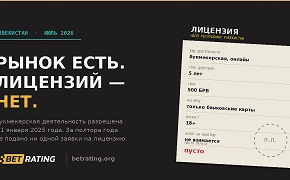
As of January 1, 2025, two areas are officially permitted in Uzbekistan: the organization of risk-based games online and betting activities. Both types require a license.
Key regulatory parameters:
- Only online. This refers to activities conducted via the internet, not a return of land-based betting shops on every corner.
- License term — five years. This is a sufficiently long horizon to recoup the initial investment, but with mandatory re-certification.
- All transactions must be conducted exclusively through bank cards. Cash is completely excluded. This is a crucial point: it makes every transaction traceable and cuts off shadow schemes.
- Strict age restrictions. Participation of individuals under 18 in games, betting, and lotteries, as well as conducting related payments, is strictly prohibited.
- Access for residents and non-residents. Both citizens of Uzbekistan and foreigners over 18 years old are allowed to play on licensed platforms.
NAPP: who issues licenses and under what conditions
The National Agency for Project Management (NAPP) has been designated as the authorized state body — a structure responsible for other complex, rapidly changing markets in Uzbekistan, including the circulation of crypto assets. The choice of regulator is indicative: the state views betting not as a "recreational" industry but as a financial-technical one that requires strict oversight.
Financial requirements for license applicants are high:
- License fee — 500 basic calculation units. At the time the rules were adopted, this amounted to approximately 187.5 million sums.
- Reserve fund. Game organizers and betting shops are required to maintain a reserve fund in banks — a mechanism that should guarantee payouts to players in case of operator problems.
- Compliance with control requirements. Player identification, checks against registers of prohibited categories, integration with banking infrastructure.
The logic of the regulator is clear: the entry barrier is intentionally set high to prevent fly-by-night companies from entering the market.
The paradox of 2026: no licenses
This is where it gets interesting. A year and a half after the rules came into effect, the situation looks like this: activities are formally permitted, the licensing procedure is approved, the regulator is appointed — but no company has obtained a license.
According to the Agency, entrepreneurs regularly seek consultations, but no official applications for licenses have been submitted. They are neither "under consideration" nor "rejected" — they simply have not been submitted.
The delay within the Agency is explained by the implementation of strict control mechanisms. The stated goal is to protect socially vulnerable groups from the negative consequences of gambling and to prevent dubious players from entering the market.
This results in a unique situation for the region: legal by law, absent in practice. The law exists, but the market does not.
Why businesses are not applying for licenses
There are few official explanations from operators, but the structure of regulation allows us to identify several likely reasons.
Entry economics. The license fee in the hundreds of millions of sums plus the mandatory reserve fund means serious frozen funds even before the first accepted bet. For an international operator, this is feasible; for a local startup, it is nearly impossible.
Narrow user funnel. The list of categories prohibited from playing is quite broad and includes recipients of social support along with their family members. This significantly reduces the potential audience compared to the "paper" population of the country.
Competition with the gray segment. While there are no licensed platforms, demand is being served by operators with foreign licenses. A company that pays for legal entry will find itself at a disadvantage: it incurs regulatory costs and is limited in audience, competing with those who bear neither.
Regulatory uncertainty. The industry is new, and there is no law enforcement practice. Businesses typically prefer to wait for a pioneer to see how the regulator behaves in practice.
The classic problem of "who goes first": as long as no one has submitted an application, the risk for each subsequent applicant remains high.
Who is prohibited from playing
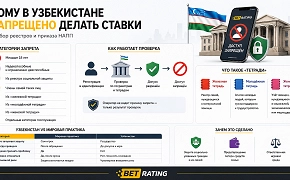
One of the most developed parts of Uzbek regulation is the social filter. A decree from NAPP has approved a list of categories prohibited from participating in risk-based games, lotteries, and betting. This includes, in particular:
- individuals who have not reached the age of majority;
- individuals declared legally incompetent or partially competent by a court;
- individuals registered in the "Unified Social Protection Register" information system, as well as their family members;
- individuals included in the "iron," "youth," and/or "women's" lists — social registers of targeted support;
- certain categories of civil servants, including employees of the prosecutor's office.
This approach deserves attention: instead of universal warnings about responsible gaming, the state has embedded protection into the very architecture of the market. A person receiving social assistance technically cannot register with a licensed operator — the verification is done against state registers.
This is perhaps the strongest distinction of the Uzbek model from most post-Soviet ones: there, restrictions are predominantly declarative, whereas here they are procedural.
Tax on winnings: an unexpected detail
A point that is often overlooked: income earned by individuals from winnings in lotteries, online games, and betting is exempt from personal income tax.
In comparison: in several neighboring countries, winnings are taxed, which is a significant expense for the player. Uzbekistan has taken a different path — the fiscal burden is placed on operators through licensing fees and capital requirements, rather than on the end user.
The logic here is transparent: to draw demand out of the shadows, the legal option must be more convenient than the illegal one. The absence of a tax on winnings is a strong argument in favor of a licensed platform. However, this argument currently has nothing to compare with.
Gray area: offshore bookmakers and their risks
While there are no licensed operators, demand has not disappeared. Users from Uzbekistan are turning to platforms operating under foreign licenses — most often from Curacao or Malta.
It is important to understand what such a license means in practice. It regulates the relationship between the operator and the jurisdiction that issued it, but does not provide protection for players from Uzbekistan. Key consequences:
- No local regulator. In case of a payout refusal, there is effectively no one to turn to in Uzbek state authorities: the operator is not accountable to them.
- No reserve fund under local control. There are no guarantees of payouts as provided by national rules.
- Payment risks. Transactions bypass the legally established scheme through bank cards, creating additional difficulties in returning funds.
- The social filter does not work. Restrictions on vulnerable categories of citizens are simply not applied on such platforms.
In other words, an international license indicates that the operator exists as a company, but says nothing about what will happen to your money in the event of a dispute. Until the national market is launched, any choice in this area remains a choice without legal protection — and this should be understood before, not after.
Why football is the engine of the whole story
It is telling that the first attempt at legalization in 2020 was framed not as a separate law on gambling, but as a decree on the development of football. Contributions from bookmakers were initially envisioned as a source of funding for sports.
The logic is clear: football in Uzbekistan is the number one sport, and the successes of the national team in recent years have significantly increased interest in it. The domestic Super League, continental tournaments, national team matches — all of this creates a natural demand for betting, which exists regardless of whether the legal market operates or not.
This demand is the main argument in favor of the idea that the reform will eventually be completed: unsatisfied demand does not disappear; it simply flows to where the state does not control it.
What will happen next
Predicting timelines in such a situation is difficult, but we can outline scenarios.
Scenario one — easing requirements. If the regulator sees that the entry barrier has become prohibitive, a correction of financial conditions is possible. This is the most likely path to launching the market.
Scenario two — the arrival of a large international operator. A company with sufficient capital enters first, gaining the advantage of being a pioneer, and others follow.
Scenario three — maintaining the status quo. Formal legalization remains on paper, and demand continues to be served from abroad. For the state, this is the worst option: no tax revenues, no control, no social protection.
For the average user, the practical conclusion today is one: there is currently no licensed bookmaker in the country, and any platform offering its services operates outside the Uzbek legal framework with all the associated risks.
Frequently asked questions
Are sports bets legal in Uzbekistan in 2026?
Betting activities have been permitted by law since January 1, 2025, provided there is a NAPP license. However, no licenses have been issued yet, so there are no licensed operators in the market.
Who issues licenses to bookmakers?
The National Agency for Project Management is the authorized body for regulating and licensing the organization of online games, betting activities, and lotteries.
How much does a license cost?
The license fee is 500 basic calculation units, which at the time of the rules' approval corresponded to approximately 187.5 million sums. Additionally, a reserve fund must be established in banks.
Is winnings taxed?
No. Income from winnings in lotteries, online games, and betting is exempt from personal income tax.
Can cash be used for payments?
No. All transactions must be conducted exclusively through bank cards.
At what age is participation allowed?
From 18 years old. Participation of minors in games, betting, and lotteries, as well as conducting related payments, is strictly prohibited.
Conclusion
Uzbekistan has built one of the most thought-out betting regulation models in the post-Soviet space: only cashless transactions, exemption of winnings from tax, reserve funds, and — what is particularly unusual — procedural rather than declarative protection for socially vulnerable groups through state registers.
The problem is that this model is not yet operational. The entry threshold has proven so high that not a single company has submitted a license application in a year and a half. The market is legalized but not created, while real demand continues to flow into jurisdictions where no one protects the Uzbek player.
How this pause will end — with eased requirements, the arrival of a major player, or the conservation of the status quo — will become clear in the coming years. For now, the situation remains a telling case of how a well-written law can fail to launch a market.
This material is informational and analytical in nature and does not constitute an invitation to participate in risk-based games. Gambling involves the risk of losing money and can lead to addiction. Participation of individuals under 18 is prohibited by law.

















































Comments 0
Please log in on the site, чтобы добавить комментарий, лайк или дизлайк.