

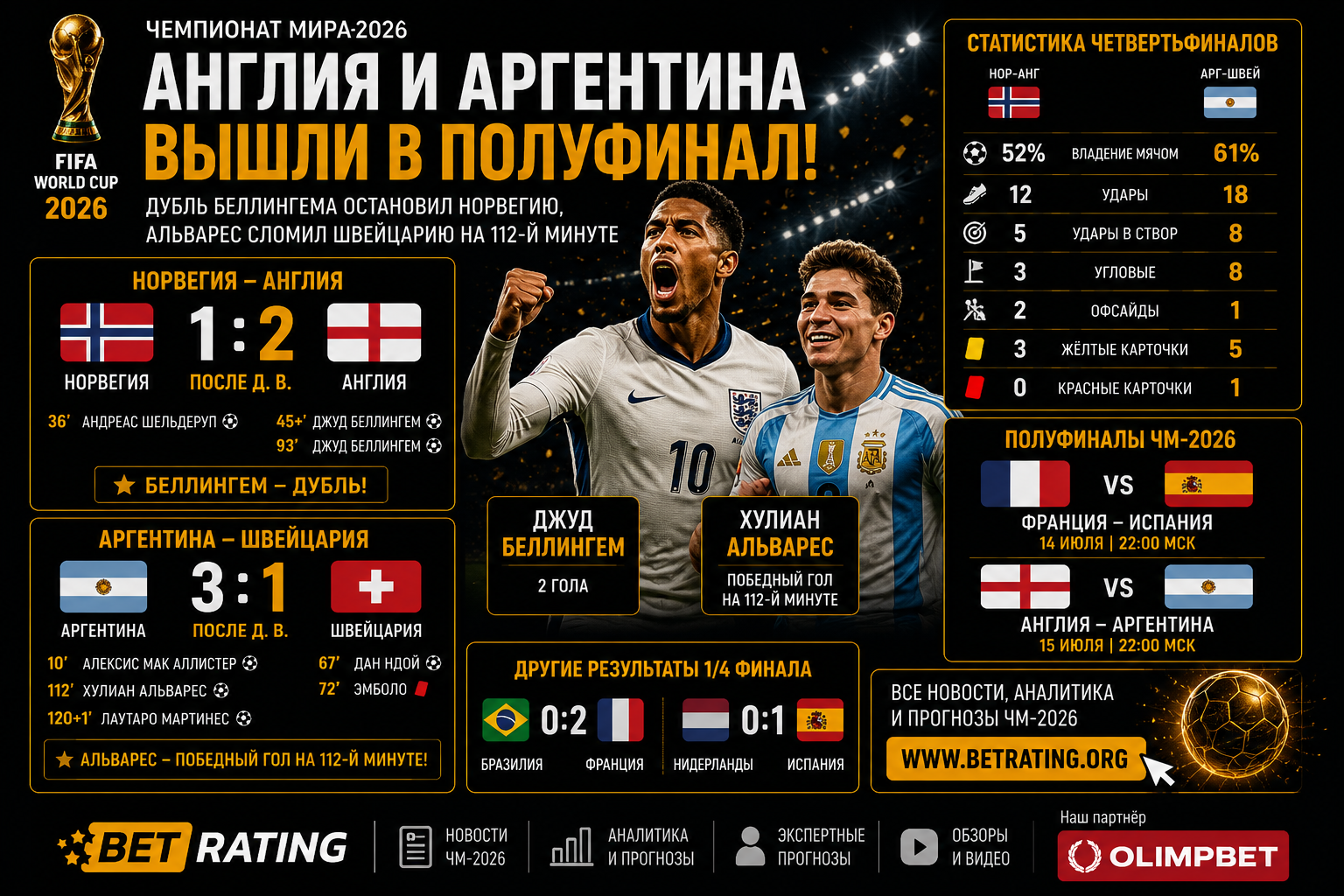
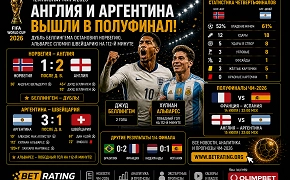
The quarterfinal matches of the 2026 FIFA World Cup have concluded. England achieved a hard-fought victory over Norway with a score of 2:1 after extra time, while Argentina triumphed over Switzerland in a tense encounter, winning 3:1.
The main hero for the English team was Jude Bellingham, who scored twice. Argentina had to search for a way to break through the defense of Switzerland, who were playing with a man down, until Julian Alvarez scored the decisive goal in the 112th minute.
Now, all the semifinal pairings for the 2026 World Cup are set. France will play against Spain, and England will face the reigning world champions, Argentina.
After the quarterfinals, four teams remain in the race for the World Cup. Current odds for the matches France vs. Spain and England vs. Argentina, as well as for reaching the final, totals, handicaps, and tournament winners are available on Olimpbet.kz .
This material is for informational purposes only. Betting involves financial risk. Please adhere to age restrictions and gamble responsibly.
Latest Quarterfinals of the 2026 World Cup: Match Results
| Match | Result | Main Hero | Semifinalist |
|---|---|---|---|
| Norway vs. England | 1:2 after extra time | Jude Bellingham - double | England |
| Argentina vs. Switzerland | 3:1 after extra time | Julian Alvarez - winning goal | Argentina |
Norway vs. England 1:2: Result and Goalscorers
| Minute | Player | Team | Score |
|---|---|---|---|
| 36' | Andreas Schelderup | Norway | 1:0 |
| 45+' | Jude Bellingham | England | 1:1 |
| 93' | Jude Bellingham | England | 1:2 |
Norway Made the Favorite Suffer Again
Norway approached the quarterfinal as one of the main revelations of the 2026 World Cup. After a sensational victory over Brazil, the Scandinavians were no longer seen as a fluke participant in the late stages of the tournament.
Against England, the Norwegian team once again relied on a compact defense, physical strength, and quick transitions. The team did not seek to constantly control the ball but aimed to exploit space quickly after English turnovers.
England had more possession, but struggled to convert territorial advantage into sustained pressure. The Norwegians tightly closed the central areas and forced their opponents to shift attacks to the flanks.
However, any interception by Norway created tension at the English goal. The speed of the attacking players and the presence of Erling Haaland forced England's defenders to constantly monitor the space behind them.
Schelderup Opened the Scoring in the 36th Minute
Norway seized their chance in the 36th minute. After a quick transition, Andreas Schelderup found an opportunity to attack the English defense and scored with a precise shot, putting his team ahead.
The goal fully aligned with the Scandinavians' game plan. England lost the ball, failed to regain their positions, and Norway quickly moved it into a dangerous area.
With the score at 1:0, the team could have tightened their defense even more and waited for new counterattack opportunities. For a few minutes, England indeed looked bewildered.
The Norwegians gained an emotional advantage and tried to capitalize on the opponent's weak period. However, they could not score a second goal.
Bellingham Saved England Before Halftime
For the English team, it was critical not to go into halftime trailing 0:1. The team increased their movement and began to deliver the ball to the penalty area more quickly.
In stoppage time of the first half, Jude Bellingham found himself in the right zone and restored parity.
The midfielder once again demonstrated the quality that makes him particularly dangerous in big matches. Bellingham can initiate an attack far from the goal and appear in the penalty area moments later as an additional striker.
The equalizer at 1:1 completely changed the psychology of the match. Norway lost the opportunity to defend their minimal lead calmly, while England gained a new match after the break.
Jude Bellingham scored both goals for England. The first brought the team back into the game before halftime, and the second in the 93rd minute secured their place in the semifinals of the 2026 World Cup.
Norway Did Not Allow England to Solve the Match in 90 Minutes
After the break, England tried to increase the pressure. The team controlled the ball longer and often occupied the opponent's half of the field.
However, the Norwegian defense continued to act in an organized manner. The central areas remained closed, and most of England's attacks went to the flanks.
Norway did not shy away from their own opportunities. The Scandinavians looked for Haaland with long passes, utilized set pieces, and tried to attack immediately after interceptions.
England had to maintain balance. Too many players forward could open space for counterattacks, so the team did not always commit maximum forces to the attack.
Regulation time ended with a score of 1:1. The quarterfinal moved into extra time, where Bellingham's individual class proved decisive once again.
Bellingham Punished Norway in the 93rd Minute
Extra time had just begun when England received a decisive chance. After a shot on goal, the Norwegian goalkeeper failed to fully neutralize the threat.
Bellingham reacted quicker than the defenders to the rebound and sent the ball into the net - 2:1.
For the first time that evening, England took the lead. Now it was Norway's turn to change their game plan and take risks.
The Scandinavians tried to organize pressure, but after a grueling 90 minutes, the quality of their attacks gradually declined. England started to play more cautiously, reduced the space between lines, and maintained their winning score.
Why Bellingham Became England's Main Hero
Bellingham's double is not just two goals in the statistics. Both goals were scored at critical moments for the team.
The first stopped a potential crisis after conceding a goal. The second allowed England to gain an advantage in extra time and forced Norway to abandon their comfortable defensive model.
Bellingham constantly changes his position during attacks. He can assist in ball progression, engage in battles in the center, and then unexpectedly join the penalty area.
Players like him are especially valuable in the playoffs. When team structure does not allow for the creation of many chances, one well-timed run can determine the fate of the tournament.
Haaland Remained Goal-less but Linked Up with the English Defense
Before the quarterfinal, one of the main storylines was Erling Haaland's confrontation with England's defenders.
The English tried not to leave the forward one-on-one. The central defenders constantly covered for each other, while the midfielders limited the number of passes directed towards Haaland.
The Norwegian striker did not receive the usual space for runs. Most passes came under pressure or far from the goal.
However, Haaland's presence still influenced the game. The English defense was forced to constantly account for his position, which opened up spaces for Schelderup and other second-line players.
Norway Concluded a Historic 2026 World Cup
The defeat to England does not overshadow the main point: Norway became one of the central stories of the World Cup.
The Scandinavians navigated several tough stages, sensationally knocked out Brazil, and forced one of the tournament favorites to play 120 minutes in the battle for the semifinals.
The team proved that its strength is not limited to Haaland. Odegaard, Schelderup, and other players formed an organized collective capable of adapting to different opponents.
The 2026 World Cup could mark the beginning of a new era for Norway. After such a tournament, the national team can no longer be perceived solely as a one-star team.
Argentina vs. Switzerland 3:1: Result and Goalscorers
| Minute | Player | Team | Score |
|---|---|---|---|
| 10' | Alexis Mac Allister | Argentina | 1:0 |
| 67' | Dan Ndoy | Switzerland | 1:1 |
| 112' | Julian Alvarez | Argentina | 2:1 |
| 120+1' | Lautaro Martinez | Argentina | 3:1 |
Mac Allister Gave Argentina an Ideal Start
Argentina opened the scoring in the 10th minute. Alexis Mac Allister was at the center of the first goal-scoring episode, putting the reigning world champions ahead.
The early goal allowed the Argentines to control the tempo. The team did not need to rush, allowing them to hold onto the ball longer and force Switzerland to expend energy on defensive movements.
The scenario was unfamiliar for the Swiss team. They had to find a way to equalize against an opponent that excels at managing the game after scoring.
However, Switzerland did not recklessly expose themselves. The European team maintained structure and gradually began to find space for their own attacks.
Switzerland Did Not Allow Argentina to Close the Match
The main problem for Argentina was the inability to quickly score a second goal. The team controlled the game but did not create a continuous flow of dangerous chances.
Swiss defenders acted attentively inside the penalty area, blocking shots and trying not to leave free space between the lines.
The longer the score remained 1:0, the more confident Switzerland became. After the break, the team started to meet the opponent higher up the pitch and utilized the flanks more often.
Argentina gradually lost absolute control of the match. Emiliano Martinez had to keep a closer eye on the development of dangerous attacks.
Ndoy Equalized in the 67th Minute
Switzerland was rewarded for their activity in the second half. In the 67th minute, Dan Ndoy finished an attack and restored parity.
The goal sharply changed the character of the quarterfinal. Argentina had to raise the tempo again and take more risks than they had planned after their early advantage.
The Swiss felt a surge of confidence. The opponent, who had previously controlled the match calmly, found themselves under serious psychological pressure.
With the score at 1:1, the stakes of each subsequent episode became maximal.
Embolo's Red Card Completely Changed the Balance of Power
In the 72nd minute, Switzerland was reduced to ten men. Breel Embolo received a second yellow card and was sent off.
After losing the forward, the European team had to significantly alter their structure. Switzerland dropped deeper and practically abandoned prolonged pressure.
Argentina gained territorial and numerical advantage. The ball was almost constantly in the opponent's half of the field.
It seemed that a second goal was just a matter of time. However, Switzerland turned the ending into a grueling test for the reigning world champions.
Switzerland played almost 50 minutes, including extra time, with ten men and came close to a penalty shootout. Argentina scored the winning goal only in the 112th minute.
Why Argentina Could Not Capitalize on Their Numerical Advantage
After Embolo's red card, the Argentines almost completely took possession of the ball but faced a saturated defense.
Switzerland defended very deep. There was minimal space between the defenders, and most passes into the penalty area were intercepted.
Lionel Messi regularly dropped deep and tried to accelerate attacks. However, several lines of the opponent constantly blocked his path.
Argentina switched the ball from one flank to another, looking for crosses and shots, but Switzerland continued to block the most dangerous attempts.
Regulation time ended with a score of 1:1. Even playing with ten men, the Swiss managed to take the quarterfinal into extra time.
Julian Alvarez Found the Solution in the 112th Minute
In extra time, the nature of the game did not change significantly. Argentina held the ball, while Switzerland defended the space directly in front of their goal.
Breaking through the dense defense with short passes became increasingly difficult. Alvarez solved the episode in a different way.
In the 112th minute, the Argentine forward received the ball outside the penalty area and unleashed a powerful shot. Gregor Kobel could not save his team - 2:1.
Alvarez's goal was the perfect response to the Swiss defensive model. If the opponent closes down space inside the penalty area, threats must be created from distance.
Argentina finally gained the advantage they had been seeking for nearly 45 minutes after Embolo's red card.
Lautaro Martinez Sealed the Deal
After conceding the second goal, Switzerland had to push forward. Even with ten men, the team could no longer continue to defend exclusively.
The space between the lines increased, and Argentina had the opportunity to utilize quick attacks.
In stoppage time of the extra period, Lautaro Martinez was the first to the rebound and set the final score at 3:1.
The final result looks quite convincing but does not fully reflect the character of the match. Until the 112th minute, Switzerland maintained a draw and was just one step away from a penalty shootout.
Messi Did Not Score but Continued to Control Attacks
Lionel Messi finished the quarterfinal without a goal, but his influence on Argentina's game remained significant.
The captain regularly dropped deep, participated in ball progression, and sought passes between the lines.
Switzerland was forced to constantly monitor his position. Several opposing players reacted to any ball received by Messi, which freed up space for his teammates.
In the semifinal against England, this role may become even more important. The English team will have to decide who will control Messi between the lines and how not to open up spaces for Alvarez in the process.
Switzerland Concluded Their Best Tournament in Decades
Switzerland reached the quarterfinals of the World Cup for the first time since 1954.
The team won their group, progressed through the previous knockout stages, and forced the reigning champions to play 120 minutes.
Even after Embolo's red card, the Swiss did not lose their discipline. The team defended in a minority for almost 50 minutes and came close to a penalty shootout.
The defeat was painful, but Switzerland's performance became one of the most notable at the 2026 World Cup.
Bellingham and Alvarez: Two Heroes of the Quarterfinal Day
| Stat | Jude Bellingham | Julian Alvarez |
|---|---|---|
| Match | Norway vs. England | Argentina vs. Switzerland |
| Scoring Efficiency | Two goals | Winning goal |
| Decisive Episode | Goal in the 93rd minute | Goal in the 112th minute |
| Main Quality | Involvement in the penalty area | Shot and unconventional solution |
| Role in Victory | Saved and put England ahead | Broke through Switzerland's deep defense |
Path of England and Argentina to the Semifinals of the 2026 World Cup
| Team | Round of 16 | Quarterfinals | Semifinals |
|---|---|---|---|
| England | DR Congo - 2:1 | Mexico - 3:2 | Norway - 2:1 after extra time |
| Argentina | Cape Verde - 3:2 | Egypt - 3:2 | Switzerland - 3:1 after extra time |
Why England Reached the Semifinals Despite Inconsistent Play
England does not yet look like a team that fully controls every match. Throughout the knockout stages, the team has faced challenging periods.
However, the depth of the squad allows them to compensate for gameplay issues. In one match, a key episode is created by a forward, in another by a winger, and against Norway, the responsibility fell on Bellingham.
England has become more psychologically resilient. Conceding a goal no longer disrupts the team's structure, and leaders are ready to take control of the game.
This quality is particularly important in the World Cup. In the later stages, it is practically impossible to play perfect matches, so the ability to endure crisis moments becomes part of the championship potential.
Why Argentina Continues to Win Tough Matches
Argentina continues to demonstrate the quality that helped them become world champions: the team knows how to survive in difficult scenarios.
Switzerland equalized, gained emotional momentum, and defended with ten men for almost 50 minutes. The Argentines needed a significant amount of time to find the winning goal.
But the team did not lose structure and did not resort to chaotic attacks. Argentina kept moving the ball, searching for weak spots, and waiting for their moment.
The experience of decisive matches remains one of the main advantages of the reigning champions. Most key players have already played under maximum pressure and understand how to maintain concentration until the last minutes.
England vs. Argentina: Second Semifinal of the 2026 World Cup
The second semifinal of the 2026 World Cup looks like a match worthy of the final. England boasts one of the deepest squads in the tournament, while Argentina continues to defend their championship title.
Both teams approach the match after 120 minutes of quarterfinal football. Therefore, recovery may become as important a factor as tactical preparation.
England has found a hero in Bellingham. Argentina has once again seen that in a tough moment, Alvarez can create the decisive episode.
However, the semifinal will not be determined solely by individual actions. The main question is which team will better control the space between the lines.
England and Argentina: Comparison Before the Semifinal
| Stat | England | Argentina |
|---|---|---|
| Quarterfinal | Norway - 2:1 | Switzerland - 3:1 |
| Main Hero | Jude Bellingham | Julian Alvarez |
| Main Style | Power and vertical attacks | Tempo control and combinations |
| Strength | Squad depth | Experience in decisive matches |
| Main Risk | Mistakes in ball progression | Space after turnovers |
Bellingham vs. Argentine Midfield
One of Argentina's main tactical tasks will be to control Bellingham.
The English midfielder is particularly dangerous not when he is constantly near the penalty area, but when he starts his movement from deep.
Defenders find it difficult to determine in advance who should meet him. If a central defender steps forward, space opens up behind him. If a midfielder fails to track the run, Bellingham gets the opportunity to finish the attack.
Argentina will need constant communication between Mac Allister, Enzo Fernandez, and the central defenders.
How England Can Stop Messi
The main problem for England is the space between the midfield and the defensive line. This is where Messi prefers to receive the ball.
If the Argentine captain can turn freely, defenders will have to step out of their positions. This will open up spaces for Alvarez and other attacking players.
England can use personal attention to Messi, but this approach creates another risk. Argentina knows how to exploit the freed-up space through a third player.
Therefore, it is important for the English not only to completely exclude Messi from the game but also to limit his ability to receive the ball facing the goal.
Recovery After 120 Minutes May Be a Key Factor
Both England and Argentina played extra time in the quarterfinals.
At this late stage of the World Cup, accumulated fatigue becomes particularly noticeable. Players have already played a large number of matches, and the intervals between games are minimal.
England has serious squad depth and can gain an advantage through substitutions. Argentina, on the other hand, has extensive experience in managing workloads in playoff matches.
The period after the 60th minute may become especially important. If the score remains level, the quality of players coming off the bench could determine the finalist.
Three Possible Scenarios for the England vs. Argentina Semifinal
| Scenario | What Will Happen | Who Benefits |
|---|---|---|
| Slow Match | A lot of positional battles and minimal space | Argentina |
| Open Football | Quick transitions and a large number of attacks | England |
| Draw After 70 Minutes | Substitutions and experience become decisive | Balance |
France vs. Spain: The First Semifinal Pair
The first semifinal will offer a completely different tactical confrontation. Spain will try to control the ball, while France is particularly dangerous in quick transitions.
The Spaniards need to minimize losses in the midfield. Any mistake could open space for French attacking players.
France, in turn, will have to spend a significant part of the match without the ball. The main question will be the team's ability to maintain compactness and not allow Spanish midfielders to work freely between the lines.
Thus, both semifinals of the 2026 World Cup offer completely different football narratives: the tactical struggle between France and Spain, and the historic confrontation between England and Argentina.
All Semifinal Pairings for the 2026 World Cup
| Date | Match | Time MSK | Main Intrigue |
|---|---|---|---|
| July 14 | France vs. Spain | 22:00 | France's speed against Spain's control |
| July 15 | England vs. Argentina | 22:00 | Bellingham against Argentina's championship experience |
Updated BET RATING Favorites Index
| Rank | Team | Status | Dynamics |
|---|---|---|---|
| 1 | France | Stable defense and dangerous quick attacks | Stable |
| 2 | Spain | Two tough victories and deep midfield | Up |
| 3 | Argentina | Continues to win tough matches | Up |
| 4 | England | Strong squad and Bellingham in decisive form | Up |
What to Consider Before Betting on the Semifinals
At the semifinal stage, it is especially important to consider not only the results of previous matches but also the physical condition of the teams.
Both England and Argentina played 120 minutes in the quarterfinals. Accumulated fatigue may affect the intensity of pressing and the quality of decisions in the second half.
France and Spain approach their confrontation with different playing models. Spain prefers to control the ball, while France can create threats without prolonged possession.
On Olimpbet.kz , you can follow the odds for the 2026 World Cup semifinals: main outcomes, reaching the final, totals, handicaps, both teams to score, and individual statistics.
Before making a prediction, it is important to wait for information about the starting lineups and the condition of players after the quarterfinals.
BET RATING Prediction for England vs. Argentina
Argentina appears slightly more prepared for the format of a decisive match. The reigning champions know how to control the tempo and have extensive experience playing under maximum pressure.
However, England has a serious advantage in squad depth. The team can change structure during the match and bring in players who immediately increase the speed of attacks.
The main threat to Argentina will be Bellingham's runs. If the English midfielder regularly enters the penalty area as a second wave, the defense will have to make difficult decisions.
England, in turn, must not allow Messi to receive the ball freely between the lines. One accurate pass can put Alvarez or another partner in a dangerous position.
BET RATING expects a cautious start. After tough quarterfinals, teams are unlikely to want to turn the opening minutes into an open exchange of attacks.
A slight advantage can be given to Argentina due to their experience in decisive matches, but in terms of squad depth and individual class, England is capable of holding their own.
FAQ: England, Argentina, and the 2026 World Cup Semifinals
How did the match Norway vs. England end?
England defeated Norway 2:1 after extra time and advanced to the semifinals of the 2026 World Cup.
Who scored for England?
Both goals for England were scored by Jude Bellingham.
Who scored for Norway?
The only goal for Norway was scored by Andreas Schelderup.
How did the match Argentina vs. Switzerland end?
Argentina defeated Switzerland 3:1 after extra time.
Who scored the goals for Argentina?
Goals for Argentina were scored by Alexis Mac Allister, Julian Alvarez, and Lautaro Martinez.
Who scored Argentina's winning goal?
The winning goal in the 112th minute was scored by Julian Alvarez.
Why did Switzerland remain with ten men?
Breel Embolo received a second yellow card and was sent off in the 72nd minute.
Who will play in the semifinals of the 2026 World Cup?
The semifinals of the World Cup will feature France vs. Spain and England vs. Argentina.
When will the match France vs. Spain take place?
The semifinal France vs. Spain will take place on July 14, 2026, at 22:00 Moscow time.
When will the match England vs. Argentina take place?
The semifinal England vs. Argentina will take place on July 15, 2026, at 22:00 Moscow time.
Who is the favorite for the 2026 World Cup according to BET RATING?
In the updated BET RATING index, France holds the first place, followed by Spain, Argentina, and England.
How many quarterfinal matches went into extra time?
The matches Norway vs. England and Argentina vs. Switzerland ended only after extra time.
Conclusion
England and Argentina became the last semifinalists of the 2026 World Cup. Both teams endured tough quarterfinals and achieved victory only in extra time.
Jude Bellingham scored a double and halted the sensational Norway. Julian Alvarez scored in the 112th minute and broke the resistance of Switzerland, who played with ten men for almost 50 minutes.
Now, four teams remain in the 2026 World Cup. France will meet Spain, and England will play against the reigning world champion, Argentina.
Stay tuned for fresh news, analysis, and predictions on BET RATING , and check the current odds for the 2026 World Cup matches on Olimpbet.kz .































































































Comments 0
Please log in on the site, чтобы добавить комментарий, лайк или дизлайк.