

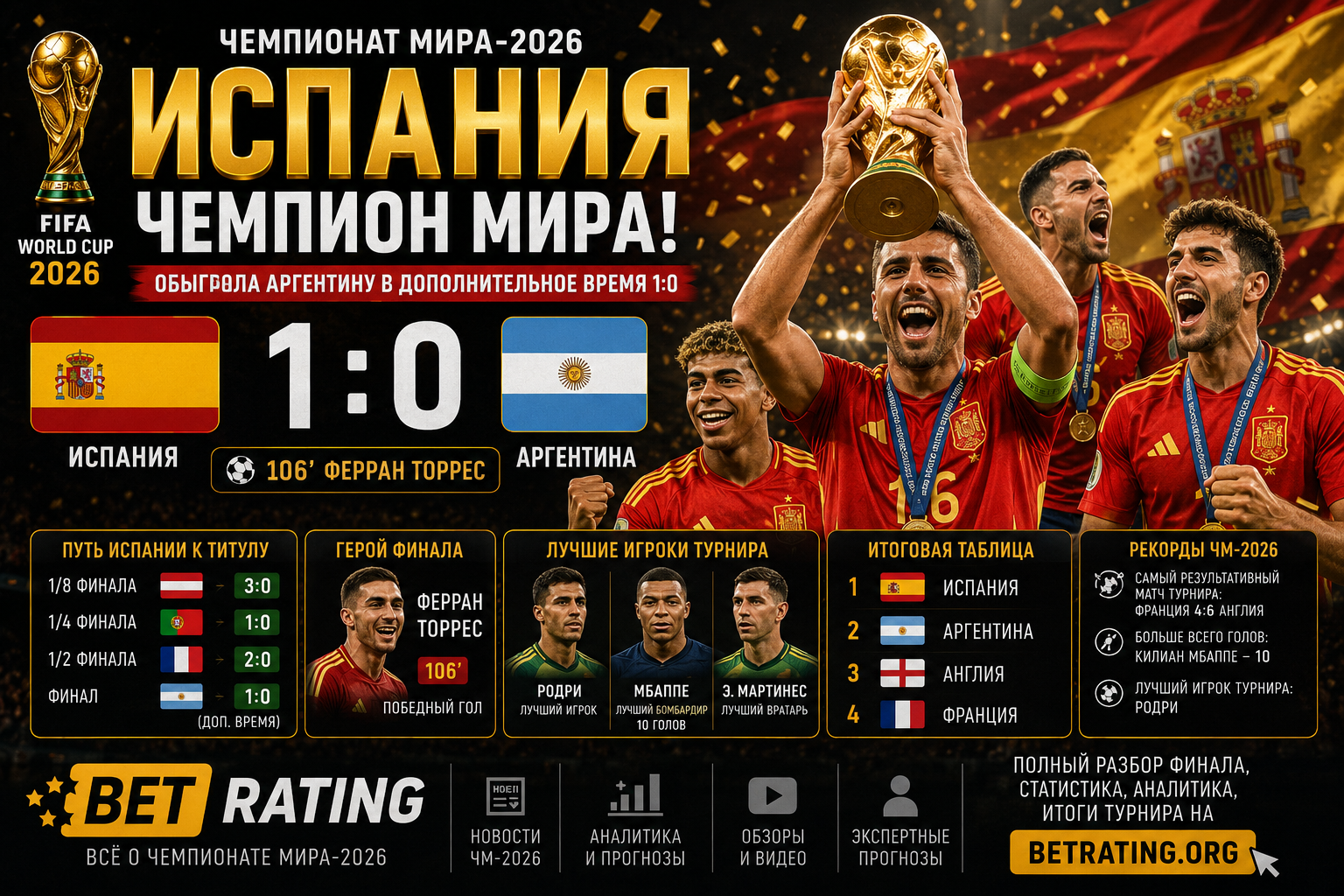
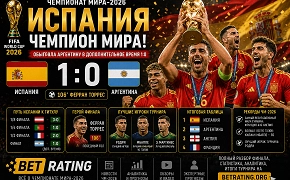
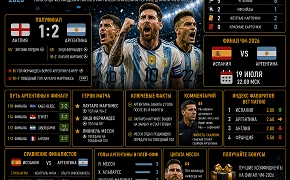
The Spanish national team became the world champion in football for 2026, defeating Argentina 1-0 in the final match. The regular time ended without any goals, and the fate of the World Cup was decided by a goal from Ferran Torres in the 106th minute.
The forward came onto the field during the match and became the main hero of the final. Spain increased the pressure in extra time, took advantage of their numerical superiority, and launched an attack that brought the country its second championship title in history.
Argentina finished the match with ten players after Enzo Fernandez was sent off. The reigning world champions tried their best to equalize the score until the end, but the Spanish defense held firm and maintained the narrow lead.
Spain repeated the achievement of the 2010 team and once again lifted the main football trophy of the planet above their heads. For the generation of Rodri, Lamine Yamal, Pedri, Nico Williams, and other leaders of the national team, this success marked the culmination of a magnificent tournament cycle.
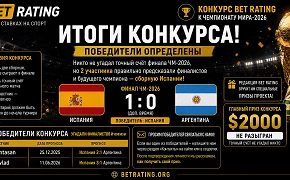
The final is over: Spain defeated Argentina 1-0 after extra time. The only goal was scored by Ferran Torres in the 106th minute.
A complete analysis of the decisive match, tournament results, statistics, and key events of the World Cup are presented on BETRATING.ORG.
Spain — Argentina 1:0: World Cup 2026 Final Result
| Parameter | Information |
|---|---|
| Match | Spain — Argentina |
| Stage | World Cup 2026 Final |
| Final Score | 1:0 after extra time |
| Score after 90 minutes | 0:0 |
| Scorer of the Winning Goal | Ferran Torres |
| Minute of the Goal | 106th |
| World Champion | Spain |
| Runner-Up | Argentina |
| Stadium | MetLife Stadium, East Rutherford |
Ferran Torres Brings the World Cup to Spain
The World Cup final remained tight and tense for a long time. Both teams understood the cost of any mistake, so there was hardly any space near the goals.
Spain controlled the ball more and tried to methodically shake the opponent's defense. Argentina played compactly, covering the central areas and relying on quick transitions involving Lionel Messi and his attacking partners.
Neither team managed to score in ninety minutes. The final went into extra time, where the depth of Spain's squad and timely substitutions by the coaching staff played a decisive role.
Ferran Torres started the match on the bench, but after coming onto the field, he significantly added movement to the Spanish attack. The forward constantly looked for open spaces between defenders and offered his teammates options for finishing passes.
In the 106th minute, the Spaniards launched the main attack of the entire tournament. The ball was delivered into the penalty area of Argentina, where Torres found himself in the right place and sent it into the net.
This strike became the championship-winning goal for Spain. Argentina had less than fifteen minutes to save the final, but Luis de la Fuente's team managed their advantage well and brought the match to victory.
Ferran Torres came onto the field from the bench and scored the only goal of the match in the 106th minute. This goal made Spain a two-time world champion.
Why the Final Was So Tight
The match between Spain and Argentina was initially seen as a confrontation between two different football concepts.
The Spanish team aimed to control space through ball possession, short passes, and constant movement of players between lines. Argentina focused on discipline, physical battles, tight defense, and the individual skills of their leaders.
The risk in the final was too great. The teams did not want to be the first to expose free spaces, so much of the battle took place in the midfield.
Spain regularly approached Argentina's penalty area, but the opponent maintained compactness. Defenders closely monitored the movements of Lamine Yamal, Nico Williams, and the Spanish midfielders.
For their part, the Argentines found it difficult to organize prolonged attacks. Spain quickly regained possession after losses and tried not to allow Lionel Messi to receive the ball in comfortable positions.
As a result, the regular time ended with a score of 0:0. The final turned into a test of endurance, where physical readiness, the quality of substitutions, and the ability to maintain concentration in extra time became crucial.
Spain Controlled the Ball, Argentina Defended the Space
From the first minutes, the Spaniards began to build their usual positional attacks. The central defenders positioned themselves widely at the start of the play, while the defensive midfielders helped advance the ball through the first line of pressure.
Argentina did not always employ high pressing. The team more often met the opponent in a medium block and tried to close passing lanes into the central zone.
Particular attention was paid by the Argentines to the flanks. Spanish wingers are capable of beating one-on-one, so defenders constantly required additional cover.
Spain patiently transferred the ball from one side of the field to the other, but not every possession ended with a dangerous moment. Argentina could retreat deeper, maintaining density near their own penalty area.
This structure allowed the South American team to hold the score at zero for a long time. However, it required a huge amount of physical work, which became increasingly difficult as the match progressed.
Lionel Messi Sought His Last Championship Moment
Great attention was focused on Lionel Messi before the final. For the 39-year-old leader of Argentina, this match could be his last appearance in World Cups.
Spain tried to limit the influence of the Argentine captain as much as possible. As soon as Messi received the ball between the lines, several opponents immediately surrounded him.
The Argentine tried several times to accelerate the attack with passes behind the defenders, but the Spanish team maintained the necessary discipline.
The closer the final whistle of regular time came, the more Argentina sought their captain. However, they could not create a decisive moment like those Messi had repeatedly created in previous stages of the tournament.
After Ferran Torres's goal, the Argentine national team pushed forward with greater force. Messi tried until the last moment to save the team, but Spain withstood the final pressure.
Enzo Fernandez's Red Card Changed the Balance of the Final
One of the key episodes of the match was the red card shown to Enzo Fernandez. The midfielder received a second yellow card, leaving Argentina with ten players before the decisive stretch of the match.
The loss of the central midfielder was particularly painful. Enzo did a lot of work, helped contain Spanish combinations, and participated in ball advancement.
After the red card, Argentina had to drop even deeper towards their own goal. Spain gained additional space, became quicker in regaining the ball, and intensified the pressure.
The numerical advantage did not guarantee victory for the Spaniards, but it significantly changed the nature of extra time. Argentine players found it increasingly difficult to cover the width of the field while simultaneously controlling players in the penalty area.
Ultimately, it was during this stretch that Spain executed the goal-scoring attack that ended with Ferran Torres's precise shot.
First Half: Cautious Start and Battle for Midfield
The beginning of the final fully corresponded to its status. Players from both teams tried to avoid unnecessary risks and carefully chose moments to advance forward.
Spain had territorial advantage, but Argentina maintained density between the lines. Attempts to deliver the ball into the central zone were often interrupted before entering the penalty area.
Argentines periodically responded with quick attacks, but Spanish defenders returned to their positions in time.
The most crucial battles took place in midfield. Neither team could establish an unambiguous advantage, and most potentially dangerous episodes ended with duels and interceptions.
The first half ended without goals. Spain worked more with the ball, Argentina successfully held off the pressure, and the final remained completely open.
Second Half: Spain's Pressure Increased
After the break, Spain began to act faster. Passes became more vertical, wide players engaged more actively in dribbling, and midfielders joined the attacks more frequently in a second wave.
Argentina responded with tight play and tried to disrupt the opponent's rhythm. As fatigue accumulated, the number of duels and fouls increased.
Argentina's goalkeeper Emiliano Martinez helped his team maintain the equal score several times. His confident play allowed the reigning world champions to take the match into extra time.
Spain continued to hold the initiative but could not deliver the decisive blow. Lamine Yamal and other attacking players regularly faced tight marking.
As the ninety minutes came to a close, the scoreboard still showed 0:0. For the first time that evening, it became clear that the fate of the World Cup would be decided beyond regular time.
Spain held the initiative, but Argentina withstood the pressure. The World Cup winner was to be determined in extra time.
Extra Time Became a Moment of Truth
In extra time, the physical condition of the players began to play an even more noticeable role. Spain retained more opportunities for active movement, while Argentina had to compensate for the loss of Enzo Fernandez.
Luis de la Fuente gained an advantage thanks to the depth of his squad. The substitutes added freshness to the attack, and Ferran Torres and Nico Williams constantly pressured the tired opponent's defense.
The first extra time did not bring any goals, but Spain's pressure grew stronger. Argentina could hold the ball less frequently and was forced to defend.
Immediately after the start of the second half of extra time, Spain delivered the decisive blow. Ferran Torres finished the attack and put his team ahead — 1:0.
The remaining time turned into a test of character for both teams. Argentina threw their last strength into saving the match, while Spain demonstrated championship composure.
Ferran Torres Became the Main Hero of the Championship Evening
Luis de la Fuente once again proved how important squad depth is in major tournaments. It was the substitutions made by the Spanish coach that changed the course of the final, which had remained absolutely even for over a hundred minutes.
Ferran Torres came onto the field in the second half and immediately began to create problems for Argentina's defenders. The forward constantly opened up between the central defenders, forcing the opponent to change their defensive structure.
In the 106th minute, Spain executed a model combination. After a quick attack, the ball reached Torres, who prepared for the shot with his first touch and accurately sent it into the net of Emiliano Martinez's goal.
This goal became the most important moment of the entire World Cup. Spain took the lead for the first time, and Argentina found themselves needing to save the match with one player less.
For Torres himself, this goal became one of the most significant in his career. The forward entered the history of Spanish football as the author of the championship goal at the World Cup.
Spain Again Proved to Be the Strongest Team in the World
The victory in the final was a logical conclusion to an impressive tournament for the Spanish national team. Throughout the championship, the team demonstrated one of the most organized and spectacular styles of football.
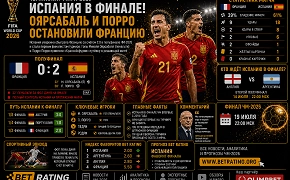
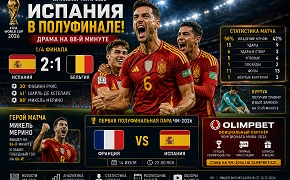
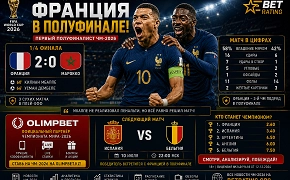
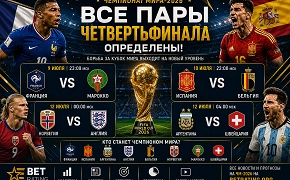
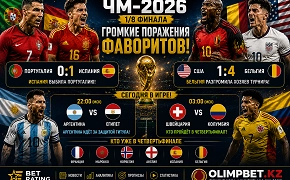
The Spaniards confidently passed the group stage, then successively eliminated Portugal, Belgium, France, and finally defeated Argentina in the final.
The team combined a high percentage of ball possession, intense pressing, and excellent defensive organization. It was this balance between attack and defense that allowed the Spaniards to navigate the entire tournament with virtually no serious setbacks.
Particularly impressive was the maturity of the young players. Lamine Yamal, Pedri, Nico Williams, and others became full-fledged leaders of the national team.
Luis de la Fuente managed to build a collective that felt equally confident in both positional attacks and when playing without the ball.
Argentina Finished the World Cup with Dignity
Despite the defeat, the Argentine national team once again confirmed its highest level. The team reached the final, demonstrating character and the ability to win difficult matches.
On the way to the decisive match, Argentina successively faced several strong opponents and proved once again that it remains one of the best national teams on the planet.
In the final, the team successfully held off Spain's pressure for a long time. Even after Enzo Fernandez's red card, the Argentines continued to fight until the last seconds of the match.
Lionel Messi concluded the tournament with yet another outstanding performance. Although winning a second consecutive World Cup was not achieved, his contribution to the development of Argentine football remains unique.
| Final Results | Significance |
|---|---|
| World Champion | Spain |
| Runner-Up | Argentina |
| Best Moment | Ferran Torres's goal in the 106th minute |
| After 90 Minutes | 0:0 |
| After Extra Time | 1:0 |
BETRATING.ORG
On our website, you can already find:
- a complete analysis of the final Spain — Argentina;
- player statistics;
- tactical analysis;
- key events of the 2026 World Cup;
- final player ratings;
- symbolic team of the tournament.
Main Heroes of the 2026 World Cup
The 2026 World Cup gifted fans many new stars and solidified the status of players who were already considered the elite of world football. The tournament was remembered for its high scoring, unexpected sensations, and a large number of bright individual performances.
One of the symbols of the championship Spain was Rodri. The midfielder controlled the pace of the game in almost every match, won a huge number of duels, and was the main organizer of his team's attacks. Rodri was named the tournament's best player and received the World Cup's "Golden Ball." [oai_citation:0‡Guardian](https://www.theguardian.com/football/live/2026/jul/19/spain-v-argentina-world-cup-2026-final-live-updates?utm_source=chatgpt.com)
Lamine Yamal confirmed his status as one of the most talented footballers of the new generation. Despite his young age, he became one of the leaders of the Spanish national team and regularly created dangerous moments at the opponents' goal.
No less important roles were played by Nico Williams, Pedri, Pau Cubarsi, Dani Olmo, and Ferran Torres. It was the depth of the squad that allowed Spain to endure a grueling tournament and maintain a high level of play all the way to the final.
For Argentina, the main hero once again was Lionel Messi. Despite his age, the captain led his team to a second consecutive World Cup final and fought until the last minutes for yet another historic title.
What the 2026 World Cup Will Be Remembered For
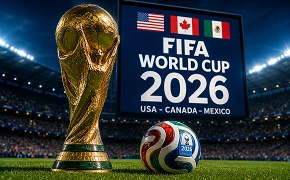
The tournament in the USA, Canada, and Mexico became the largest in the history of world football. For the first time, 48 national teams participated, allowing fans to see a record number of matches and many new football stories.
The championship produced several sensations. Many favorites exited earlier than expected, while some teams made it to the decisive stages of the tournament for the first time.
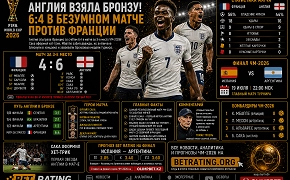
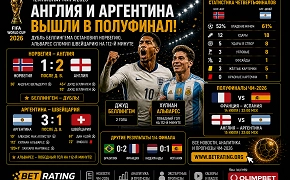
The semifinals, the third-place match, and the final were particularly spectacular. England defeated France 6-4 in the highest-scoring playoff match, while Spain and Argentina determined the stronger team only in extra time.
The final was a complete contrast to the bronze match. Instead of open football, viewers witnessed a tactical battle where the only goal proved decisive.
Why Spain's Victory Has Historical Significance
The second title of world champions firmly established Spain among the greatest football powers on the planet. After the success in 2010, the team returned to the pinnacle of world football sixteen years later. [oai_citation:1‡Guardian](https://www.theguardian.com/football/live/2026/jul/19/spain-v-argentina-world-cup-2026-final-live-updates?utm_source=chatgpt.com)
Just a few years ago, the Spanish national team was undergoing a generational change, but the new generation of players managed to restore the country's status as a world leader.
The victory in the final confirmed that the bet on young footballers fully paid off. Luis de la Fuente's team combined experience and youth, demonstrating modern and effective football.
Many experts already consider the current Spain one of the strongest national teams of the last decade due to the quality of play, stability, and immense potential of the squad.
2026 World Cup Results
- 🥇 Champion — Spain
- 🥈 Silver — Argentina
- 🥉 Bronze — England
- 🏅 4th place — France
- ⭐ Best Player of the Tournament — Rodri
- ⚽ Top Scorer — Kylian Mbappe (10 goals)
BETRATING.ORG — All About the 2026 World Cup
BETRATING.ORG has published dozens of exclusive materials about the 2026 World Cup. Our experts have thoroughly analyzed each playoff match, prepared statistics, player ratings, tactical analyses, and predictions.
If you want to learn more about Spain's path to the championship title, the best players of the tournament, and key events in world football, follow the updates on BETRATING.ORG.
Conclusion
The final of the 2026 World Cup fully met the expectations of millions of fans. Despite the absence of goals in regular time, the match kept everyone on edge until the last seconds due to the highest level of football, tactical battles, and the incredible cost of each mistake.
Spain proved to be the strongest national team in the world. Luis de la Fuente's team navigated the entire tournament almost flawlessly, and the victory over Argentina was a well-deserved result of years of work on renewing the national team.
The championship goal by Ferran Torres will forever go down in the history of Spanish football, and the victory in the USA, Canada, and Mexico will be one of the brightest achievements of the new generation of players.
Argentina also deserves immense respect. The team once again reached the World Cup final, and Lionel Messi concluded yet another outstanding tournament, confirming his status as one of the greatest footballers of all time.
The 2026 World Cup has concluded, but its main moments will be discussed by fans around the world for a long time. Spain has once again ascended to the football Olympus, and the world game has gained a new deserving champion. [oai_citation:0‡Olympic Games](https://www.olympics.com/en/news/fifa-world-cup-2026-spain-argentina-final-score-lineups-live-updates?utm_source=chatgpt.com)
BETRATING.ORG
Stay updated with the latest news in world football with BETRATING.ORG.
- ✓ Football news
- ✓ Match analysis
- ✓ Player statistics
- ✓ Expert predictions
- ✓ Results of major tournaments
FAQ
Who became the world champion in 2026?
The Spanish national team, which defeated Argentina 1-0 after extra time.
Who scored the winning goal?
Ferran Torres scored in the 106th minute of extra time. [oai_citation:1‡Olympic Games](https://www.olympics.com/en/news/fifa-world-cup-2026-spain-argentina-final-score-lineups-live-updates?utm_source=chatgpt.com)
How did regular time end?
The first 90 minutes ended with a score of 0:0.
Who received the Golden Ball of the World Cup?
The best player of the tournament was Spain's captain Rodri. [oai_citation:2‡AP News](https://apnews.com/article/world-cup-golden-boot-awards-messi-mbappe-2036d505bc97ce3a116f20dd67db43e5?utm_source=chatgpt.com)
Who became the top scorer of the 2026 World Cup?
Kylian Mbappe won the "Golden Boot," scoring 10 goals and becoming the first two-time winner of this award. [oai_citation:3‡AP News](https://apnews.com/article/world-cup-golden-boot-awards-messi-mbappe-2036d505bc97ce3a116f20dd67db43e5?utm_source=chatgpt.com)
How many World Cup titles does Spain have now?
Two — after victories in 2010 and 2026.
Follow the biggest football events with OLIMPBET. Current odds, a wide range of bets on world football, and special offers are available on our official partner's website.








































































Comments 0
Please log in on the site, чтобы добавить комментарий, лайк или дизлайк.